Security Analytics

Manage risk effectively with security analytics

For enterprises today, the digital ecosystem is constantly increasing in size and complexity. Workforces are becoming more mobile, with employees increasingly using their own devices to access corporate networks and assets. Enterprises are embracing cloud services that deliver greater agility and productivity, but that comes with greater risk as well. In the face of all this change, IT teams need superior security analytics that can provide greater visibility into the organization’s digital footprint and into the effectiveness of security programs.

Bitsight is transforming cyber risk strategy and cybersecurity performance management with detailed, objective security analytics. Our industry-leading security ratings deliver insight into security performance and risk concentrations.

Essential metrics for security analytics

Understanding risk within your IT environment – and how effective your security programs are at mitigating it – is essential to strengthening your cybersecurity posture and mitigating risk in your supply chain. The following metrics are an essential part of effective security analytics.

  • Security ratings. Bitsight Security Ratings evaluate a company’s overall cybersecurity performance based on externally observable key risk indicators from more than 120 sources. Ratings are based on information about a company’s compromised systems, security diligence, user behavior, and data breaches.
  • Botnet infections. Understanding the frequency, severity, and duration of botnet infections within a network gives security leaders insight into how likely their company is to fall victim to a data breach.
  • Open ports. Hackers can exploit open to gain access to sensitive systems and data. Organizations with more open ports are more likely to experience a breach than companies with fewer.
  • Intrusion attempts. Understanding how many intrusion attempts were detected and blocked can help identify the risk that systems and data face daily.
  • Patching cadence. The rate at which critical security patches are applied is an essential metric for security analytics. Slow patching cadence indicates either a lack of diligence or lack of resources, and organizations that fail to apply critical security patches in a timely manner may be exposing themselves to potentially dangerous cyber risks. In fact, Bitsight research shows that slow patching cadence is strongly correlated with ransomware attacks.
  • Phishing test success rate. Organizations that conduct phishing tests can get a better read on how likely their employees are to fall for phishing attempts.
  • Average password strength. This metric is a simple indicator of risk, and one that can be easily mitigated.
  • Unidentified devices on the network. Security teams have less control over unidentified devices than over company devices. The number of unidentified devices is directly related to an increase in cyber risk.

Security analytics from Bitsight

As the most trusted, transparent, and transformative cyber risk analytics company, Bitsight provides organizations with security analytics solutions for managing security performance and mitigating third-party risk. With Bitsight analytics, security teams gain visibility into the entire digital ecosystem to continuously monitor risk as well as the effectiveness of security programs.

Bitsight’s security analytics solution offers a centralized dashboard where you can view all digital endpoints organized by cloud provider, business unit, and geography. By tracking security metrics daily, your teams can quickly identify the areas of greatest risk and make plans for immediate remediation. Bitsight’s data analytics & cybersecurity reporting features enable security and risk leaders to confidently share security analytics with business executives and the board, using language and metrics that are easily understood by technical and non-technical personnel alike.

Bitsight for Security Performance Management (SPM) enables organizations to continuously monitor the effectiveness of security controls over time. Security analytics within the SPM platform include:

  • Attack surface analytics. This security analytics solution continuously discovers and segments the assets, applications, and devices within your digital footprint. With Bitsight, you can visualize areas of disproportionate risk and gain visibility into all digital assets that need to be secured. You can also discover hidden assets and shadow IT instances, assessing them for risk and bringing them in line with corporate security policies.
  • Enterprise analytics. Bitsight delivers visibility into security performance across units, subsidiaries, and other organizational groups, taking the guesswork out of identifying risk concentration and enhancing security performance throughout the organization.
  • Peer analytics. Gain visibility into your security’s relative performance strength as compared to peers and competitors. Benchmark your programs against other organizations in your industry or against companies of similar size to make more informed decisions about where to focus cybersecurity efforts.

Security analytics for third-party risk

Bitsight for Third-Party Risk Management (TPRM) enables risk leaders to measure and continuously monitor third-party security controls, taking action to mitigate risk for third and fourth parties. This Bitsight solution enables teams to quickly and confidently ensure that new vendors are within the organization’s risk tolerance, and it manages constantly changing risk levels throughout the vendor lifecycle. Continuous monitoring complements traditional vendor risk assessments, enabling third-party risk management teams to track changes, prioritize responses, and drive remediation through proactive, evidence-based collaboration. Additionally, Bitsight security analytics for IT vendor risk management make it easier to measure the performance of cyber controls across the vendor portfolio.

Why choose Bitsight?

An industry-leading solution

Bitsight is the world’s leading provider of cyber risk intelligence, transforming how security leaders manage and mitigate risk. Leveraging the most comprehensive external data and analytics, Bitsight empowers organizations to make confident, data-backed decisions and equips security and compliance teams from over 3,300 organizations across 70+ countries with the tools to proactively detect exposures and take immediate action to protect their enterprises and supply chains. Bitsight customers include 38% of Fortune 500 companies, 4 of the top 5 investment banks, and 180+ government agencies and quasi-governmental authorities, including U.S. and global financial regulators.

Extensive visibility

Bitsight operates one of the largest risk datasets in the world. Leveraging over 10 years of experience collecting, attributing, and assessing risk across millions of entities, we combine the power of AI with the curation of technical researchers to unlock an unparalleled view of your organization. Bitsight offers more complete visibility into important risk areas such as botnets, mobile apps, IoT systems, and more. Our cyber data collection and scanning capabilities include:

  • 40 million+ monitored entities
  • 540 billion+ cyber events in our data lake
  • 4 billion+ routable IP addresses 
  • 500 million+ domains monitored
  • 400 billion+ events ingested daily
  • 12+ months of historical data

Superior analytics

Bitsight offers a full analytics suite that addresses the challenges of peer comparison, digital risk exposure, and future performance.

Ratings validation

Bitsight is the only rating solution with third-party validation of correlation to breach from AIR Worldwide and IHS Markit.

Quantifiable outcomes

Bitsight drives proven ROI with significant operational efficiency and risk reduction outcomes.

Prioritization of risk vectors

Bitsight incorporates the criticality of risk vectors in to calculation of Security Ratings, highlighting risk in a more diversified way to ensure the most critical assets and vulnerabilities are ranked higher.

Cloud Security Metrics

Mitigating Risk With Cloud Security Metrics

As the volume of attacks on cloud services continues to rise, CISOs and their teams need clear metrics for monitoring, assessing, and mitigating risk. However, a lack of visibility makes it challenging to track cybersecurity and cloud security metrics effectively. As your organization relies more heavily on cloud services and your workforce becomes increasingly remote, getting a clear view of your attack surface is more complex than ever. Without continuous visibility into all your assets in the cloud, it’s difficult to establish meaningful cloud security metrics and achieve superior cybersecurity protection.

Bitsight can help. Bitsight Attack Surface Analytics lets you shine a light on your attack surface as it expands to the cloud and remote environments. Bitsight gives your security team continuous, broad visibility and context into your attack surface in the cloud and across hosting providers, so you can better monitor the most effective cloud security metrics and understand the risk profile of all your cloud-hosted assets.

Nine Security Metrics To Watch

Monitoring risk and improving security performance in the cloud and throughout your digital ecosystem begins with monitoring the right cloud and cyber risk metrics. Specific, quantifiable metrics can help you build a security program that thoroughly addresses the external, internal, and supply chain threats.

To monitor external threats, you’ll want to watch metrics like:

  • The number of botnet infections per device over a period of time. This metric forces you to examine how many and what kind of botnets have infiltrated your network, and whether botnets are installing malware or performing data exfiltration.
  • The number of unpatched known vulnerabilities. This metric can help to ensure that you’re adequately patching your own network, or if risks are left unpatched for dangerous amounts of time.
  • The number of properly configured SSL certificates. Monitoring this metric can help you determine whether your SSL certificates meet the accepted level of security and whether servers are properly configured.

To monitor for internal threats, it’s helpful to track metrics like:

  • The frequency with which employee access is reassessed. Waiting to reassess employees for prolonged periods of time could be a cause for concern and cause phishing attempts and improper access to go undetected.
  • The amount of peer-to-peer filesharing activity. The number of files that have been shared or downloaded through unauthorized technologies is typically a good measure of security posture.
  • The percentage of “super users.” Higher numbers of super users – employees that have broad access to data within the organization – may increase your chances of an insider-based attack.

To track threats within your supply chain, you can monitor metrics such as:

  • The number of open ports. Monitoring open ports over a period of time can help you understand whether third-party vendors are leaving channels exposed to bad actors using unencrypted channels.
  • The percentage of third-party software that is scanned for vulnerabilities before deployment. If this metric is less than 100%, your corporate network could be at risk.
  • The percentage of vendors whose cybersecurity effectiveness is continuously monitored. Continuous monitoring solutions help you keep an eye on third-party risk in the weeks and months between questionnaires, audits, and penetration tests, and sometimes take the place of these manual assessments altogether.

Bitsight Attack Surface Analytics

Bitsight Attack Surface Analytics allows you to overcome visibility challenges and to get a handle on the risk hidden in your digital assets in the cloud as well as other geographies, subsidiaries, and remote IT environments. As part of Bitsight for Security Performance Management, this Bitsight solution lets you continuously discover, segment, and assess risk for all your cloud-hosted assets.

In addition to cloud security metrics, Bitsight Attack Surface Analytics provides visibility into your entire digital ecosystem. With Bitsight, you can:

  • Enjoy unprecedented visibility into all digital endpoints. Rather than manually tracking asset inventory via spreadsheets, your teams can automatically discover vulnerabilities throughout your ecosystem and identify their location for faster remediation.
  • Discover shadow IT instances. Superior security requires a strategy to deal with shadow IT – those technologies that are spun up by teams or individuals without the knowledge or approval of your IT staff. Bitsight lets you easily discover shadow IT and the associated risks and threats, including cloud providers or cloud-based applications that are not a part of your inventory of contracted vendors.
  • Identify areas of disproportionate risk. With a view of your digital assets that spans your entire ecosystem, you can easily search for areas of critical or excessive risk and prioritize them for remediation.
  • Measure risk on remote networks. Bitsight simplifies the task of gaining visibility into risk associated with unmonitored and insecure home and remote offices. Your security teams can discover new business risk associated with remote environments and determine appropriate risk mitigation measures.

How Bitsight Monitors Cloud Security Metrics

Bitsight Attack Surface Analytics provides a centralized dashboard that shows the location of your digital assets broken down by cloud provider, geography, and business unit. It also reveals the risk associated with each endpoint so you can quickly prioritize efforts for remediation.

For example, with clear visibility into your cloud footprint, you can view the security of cloud-hosted assets based on the number of material and severe findings. These may reveal unknown vulnerabilities, misconfigurations, and infections that could expose your organization to the risk of a breach.

Bitsight Attack Surface Analytics also offers additional context, including geographic location. A map-based view on the dashboard puts an end to guessing about security risk locations. Your teams can determine the precise location of a vulnerable endpoints in the cloud and prioritize remediation efforts by ranking asset importance by cloud provider.

If you’re using multi-cloud environments, you can compare the security posture of multiple instances within one provider or the security of instances across providers Your teams can identify cloud instances that fail to adhere to corporate security policies, allowing them to quickly and easily bring these instances into alignment by identifying the exact risk-points that aren’t up to par.

Why choose Bitsight?

An industry-leading solution

Bitsight is the world’s leading provider of cyber risk intelligence, transforming how security leaders manage and mitigate risk. Leveraging the most comprehensive external data and analytics, Bitsight empowers organizations to make confident, data-backed decisions and equips security and compliance teams from over 3,300 organizations across 70+ countries with the tools to proactively detect exposures and take immediate action to protect their enterprises and supply chains. Bitsight customers include 38% of Fortune 500 companies, 4 of the top 5 investment banks, and 180+ government agencies and quasi-governmental authorities, including U.S. and global financial regulators.

Extensive visibility

Bitsight operates one of the largest risk datasets in the world. Leveraging over 10 years of experience collecting, attributing, and assessing risk across millions of entities, we combine the power of AI with the curation of technical researchers to unlock an unparalleled view of your organization. Bitsight offers more complete visibility into important risk areas such as botnets, mobile apps, IoT systems, and more. Our cyber data collection and scanning capabilities include:

  • 40 million+ monitored entities
  • 540 billion+ cyber events in our data lake
  • 4 billion+ routable IP addresses 
  • 500 million+ domains monitored
  • 400 billion+ events ingested daily
  • 12+ months of historical data

Superior analytics

Bitsight offers a full analytics suite that addresses the challenges of peer comparison, digital risk exposure, and future performance.

Ratings validation

Bitsight is the only rating solution with third-party validation of correlation to breach from AIR Worldwide and IHS Markit.

Quantifiable outcomes

Bitsight drives proven ROI with significant operational efficiency and risk reduction outcomes.

Prioritization of risk vectors

Bitsight incorporates the criticality of risk vectors in to calculation of Security Ratings, highlighting risk in a more diversified way to ensure the most critical assets and vulnerabilities are ranked higher. 

FAQs: What Are Cloud Security Metrics?

Get a complete view of your organization’s attack surface — both on-premise and in the cloud and discover where your organization's cyber risk is.  

  • We will use your information to communicate with you about this contact form and other solutions and related resources that may be of interest to you. You may unsubscribe at any time. For more information, please see our Privacy Policy.

  • By submitting this form, you agree to the Security Ratings Access Terms.

Cybersecurity Report

What is a cybersecurity report?

A cybersecurity report presents critical information about cybersecurity threats, risks within a digital ecosystem, gaps in security controls, and the performance of security programs. Cybersecurity reports help to foster data-driven communication between boards, executives, security and risks leaders, and security practitioners to ensure that all parties are working together to enhance security programs and mitigate risk.

Essential elements of a cybersecurity report

The content in a cybersecurity report is determined by the audience. Boards and executives require high level metrics that provide an overview of security performance and flag significant risk exposure. Security and risk leaders require more detailed reports that help to identify the largest areas of risk and prioritize investment and resources. Security practitioners require data that can help to remediate specific issues and identify the optimal course of action to improve cybersecurity posture.

Protecting the organization with cybersecurity reports

As the volume and sophistication of cyberattacks continue to grow, risk-based security reporting has become an indispensable tool for security and risk management professionals. Effective communication between all levels of an organization – from security teams and risk managers to the C-suite and the board – is essential to managing risk, refining security programs, and protecting the organization. A risk-based cybersecurity report enables stakeholders to assess performance based on actual exposure to cyber threats while providing context, highlighting the success of security efforts, and ensuring that resources and investments are aligned with goals.

Bitsight Security Ratings provide concise data and meaningful context for risk-based reporting on security performance and third-party risk. Leveraging the objective, verifiable data provided by Bitsight, organizations can produce cybersecurity reports that allow stakeholders at all levels of an organization to focus on the most significant issues and work together to mitigate risk and defend against threats.

Risk-based cybersecurity report best practices

Risk-based cybersecurity reporting is distinct from compliance-based, incident-based, or comprehensive reporting. Risk-based cyber security reports are the type of communication that is best-suited to reduce an organization’s actual exposure to cyber threats. A risk-based approach to reporting ensures that everyone from the board to practitioners on security teams can stay focused on the most significant issues and the highest priority actions required to reduce exposure to cyber threats.

Risk-based cybersecurity reports are guided by several best practices:

Show risk first

Highest risk items should be front and center in the report to ensure they command the attention that they require.

Assign scores

Assigning a risk score to key findings or recommendations can help non-technical readers to interpret findings and compare priorities.

Provide context

Putting findings in context by comparing metrics to past performance, peers, and competitors helps everyone to focus on aligning resources with the highest priorities for risk mitigation.

Show ramifications

Framing risk in business terms can help executives and leaders understand the implications of findings.

Report often

Reporting on critical items frequently or implementing continuous reporting dashboards ensures that the items most in need of attention and resources will get them.

Delivering the context of a cybersecurity report

When a cybersecurity report delivers findings in context, readers can better understand how the numbers in the report relate to the overall risk landscape for the organization. Context may include everything from a review of past performance to the impact of cyber risk to the bottom line to cybersecurity frameworks within the industry. When receiving data in context, security professionals can make more informed, data-driven decisions about the allocation of resources and prioritization of tasks.

Bitsight reporting capabilities enable risk managers to provide context that includes:

  • Past performance. Bitsight can identify how today’s ratings compare to ratings last month or last quarter and whether the ratings are improving or declining over time.
  • Risk concentration. Bitsight can reveal how different business units and subsidiaries across organizations are performing.
  • Industry benchmarks. Bitsight reports show how security performance compares to peers and competitors.
  • Financial quantification. Risk managers can identify the financial impact of an organization’s current risk posture.
  • Cybersecurity frameworks. Reports can also reveal how findings align with important frameworks in the cybersecurity industry.

Bitsight for Security Performance Management

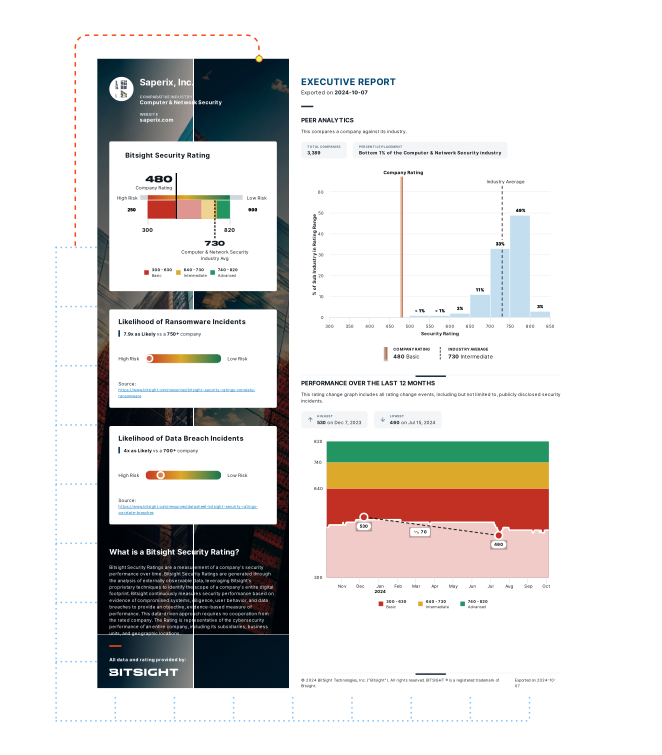
Bitsight transforms how companies manage cyber risk. Bitsight Security Ratings offer a data-driven, dynamic measurement of an organization’s cybersecurity performance. As a form of continuous cyber security monitoring, Bitsight ratings provide immediate insight into an organization’s security performance and into the security posture of vendors. Bitsight ratings also are proven to correlate to the risk of a data breach. Research has shown that companies with a Bitsight Security Rating of 500 or lower are nearly 5 times more likely to have a breach those with a rating of 700 or above1.

Bitsight enables risk managers to produce more effective cyber risk reports. Bitsight’s reporting capabilities allow cybersecurity teams to adhere to all the best practices for risk-based reporting.

  • Overview and executive reporting options are designed to satisfy the requests and answer the questions of company stakeholders. Risk managers can summarize risk across the vendor portfolio, laying the groundwork for data-driven conversations at the board and executive level about managing risk.
  • Comparison reports allow organizations to take a detailed look at how all aspects of their cybersecurity programs stack up against other companies, including competitors, partners, and vendors. Reports on security benchmarks help organizations better understand how their vulnerabilities and vendor risk requirements compare to the companies they’re competing against.
  • History and trend reports provide context for interpreting today’s security ratings. Analyzing historical data can help prepare security teams to react quicker to future threats. Analyzing trends can highlight past vulnerabilities and risky areas that might require continuous monitoring.

Why choose Bitsight?

An industry-leading solution

Bitsight is the world’s leading provider of cyber risk intelligence, transforming how security leaders manage and mitigate risk. Leveraging the most comprehensive external data and analytics, Bitsight empowers organizations to make confident, data-backed decisions and equips security and compliance teams from over 3,300 organizations across 70+ countries with the tools to proactively detect exposures and take immediate action to protect their enterprises and supply chains.

Bitsight customers include 38% of Fortune 500 companies, 4 of the top 5 investment banks, and 180+ government agencies and quasi-governmental authorities, including U.S. and global financial regulators.

Extensive visibility

Bitsight operates one of the largest risk datasets in the world. Leveraging over 10 years of experience collecting, attributing, and assessing risk across millions of entities, we combine the power of AI with the curation of technical researchers to unlock an unparalleled view of your organization. Bitsight offers more complete visibility into important risk areas such as botnets, mobile apps, IoT systems, and more. Our cyber data collection and scanning capabilities include:

  • 40 million+ monitored entities
  • 540 billion+ cyber events in our data lake
  • 4 billion+ routable IP addresses 
  • 500 million+ domains monitored
  • 400 billion+ events ingested daily
  • 12+ months of historical data

Superior analytics

Bitsight offers a full analytics suite that addresses the challenges of peer comparison, digital risk exposure, and future performance.

Ratings validation

Bitsight is the only rating solution with third-party validation of correlation to breach from AIR Worldwide and IHS Markit.

Quantifiable outcomes

Bitsight drives proven ROI with significant operational efficiency and risk reduction outcomes.

Prioritization of risk vectors

Bitsight incorporates the criticality of risk vectors in to calculation of Security Ratings, highlighting risk in a more diversified way to ensure the most critical assets and vulnerabilities are ranked higher.

Cybersecurity Budget

How to Justify your Cybersecurity Budget

After years of heavy spending on security, boards and executives are increasingly concerned about the ROI of their cybersecurity budgets. This may be due in part to problems in communication between upper-level management and security professionals. Senior leaders aren’t always clear on how cybersecurity investments today can prevent cyberattacks in the future. At the same time, security leaders are often negligent in demonstrating how cybersecurity budgets align with business goals.

One reason for this disconnect between is a lack of quantitative, objective cyber security metrics that are easy to understand. Many metrics are too detailed to comprehend, too vague to matter, or lacking in meaningful context.

Bitsight can help. Bitsight Security Ratings provide a data-driven, dynamic measurement of the cybersecurity performance of an organization and its vendors. Armed with daily Bitsight ratings, security managers can facilitate data-driven conversations about security and risk with boards and executives while effectively justifying their cybersecurity budgets.

Five Ways to Justify a Cybersecurity Budget When Facing Cuts

As security managers face increasing scrutiny and shrinking budgets, these five strategies can help to justify the cybersecurity budgets they need to optimize cybersecurity planning to align to the broader goals of the business.

Understand risk to prioritize spending

To demonstrate ROI, security leaders need tools that deliver greater visibility into risk in their digital ecosystem. By identifying areas of highest or disproportionate risk, teams can prioritize security spending and introduce cyber risk reduction programs that will deliver fast and noticeable impact.

Use risk-based metrics to justify funding

Too often, security professionals provide senior leadership with metrics that aren’t correlated with business outcomes. By leveraging metrics that have a direct relationship to positive or negative outcomes, security teams can show that their work has potential to help the business grow, scale, and increase profitability. Metrics that correlate to the risk of data breaches are especially effective, as senior leadership is painfully aware of the potential cost of cyberattacks.

Benchmark performance to prioritize investments

By benchmarking the performance of their organization against peers and competitors, security managers can prioritize security efforts to achieve the highest impact while meeting or surpassing industry benchmarks.

Uncover risk in remote office networks

More employees are working remotely or from home today, significantly increasing the company’s attack surface and introducing new vulnerabilities. According to research, residential IPs account for more than 90% of all observed malware infections and compromised systems. Security managers can justify cybersecurity budgets by improving cyber risk management in remote operating and work from home environments.

Evaluate third-party risk more cost-effectively

Vendors and partners are often the weak link in a company’s security chain. Yet managing third-party risk can be labor-intensive and costly. With tools that significantly reduce the time and expense of onboarding, risk managers can promote business enablement while cost-effectively evaluating and mitigating risk.

Maximizing Cybersecurity Budgets with Bitsight

Bitsight offers the most widely adopted Security Ratings solution in the industry. With Bitsight’s suite of cybersecurity and risk management technologies, companies can solve their most complex cyber risk challenges.

Bitsight Security Ratings are the foundation for all Bitsight solutions. Providing a dynamic, data-driven measurement of an organization’s security performance, Bitsight ratings provide greater security visibility and enable security managers to proactively identify, quantify, and manage cyber security risk throughout their ecosystem.

Unlike existing security tools that conduct periodic scans or rely on subjective cyber risk assessments, Bitsight Security Ratings continuously measure security performance based on evidence of compromised systems, security diligence, user behavior, and data breaches. Bitsight Security Ratings are generated daily through the analysis of externally observable data in an outside-in approach that requires no information from the rated entity. With Bitsight ratings, organizations can monitor third- and fourth-party risk, make data-driven risk decisions with greater speed and effectiveness, and engage stakeholders in data-driven conversations about risk and security.

Bitsight Solutions for Cybersecurity and Risk Management

Bitsight’s technology provides the quantitative, objective, and continuous metrics that security leaders need to justify their cybersecurity budget. Bitsight solutions include:

  • Bitsight Third-Party Risk Management. Bitsight immediately exposes cyber risk within supply chains, focusing budgets and resources to achieve measurable cyber risk reduction. With a view of the riskiest issues impacting vendors, risk managers can optimize third-party risk management programs with the cybersecurity budgets they have today.
  • Bitsight for Security Performance Management. Bitsight enables security and risk leaders to accurately measure the performance of their programs and align investments and budgets with actions that produce the highest impact over time. With Bitsight, security professionals can efficiently allocate limited cybersecurity budgets to the most critical areas of cyber risk within the organization.
  • Bitsight Attack Surface Analytics. Bitsight delivers a clear view of the attack surface, the assets within it, and the associated risks. By identifying areas of disproportionate risk, security teams can better prioritize remediation efforts.
  • Bitsight Security Ratings for Benchmarking. Security leaders rely on Bitsight to assess and monitor their cybersecurity posture, benchmark their performance against competitors and peers, and report results to senior leadership more clearly and effectively.
  • Bitsight Security Ratings for Executive Reporting. Bitsight’s reporting capabilities facilitate data-driven conversations to help teams communicate more effectively about security and risk. With Bitsight cyber risk reports, security leaders can identify gaps in security controls and programs and determine where to focus cybersecurity budgets for the highest impact on performance.

Why choose Bitsight?

Bitsight has been transforming the way companies manage cybersecurity and risk since 2011. As the most widely adopted security rating service in the world, Bitsight continuously monitors large pools of objective and independently verified data to deliver actionable security ratings, cyber risk metrics, and security benchmarks.

More than 2,100+ customers, including some of the world’s largest organizations, rely on Bitsight to provide a clearer picture of their security posture. Bitsight is the choice of 25% of Fortune 500 companies, 20% of the world’s countries, and 7 of the top 10 largest cyber insurers. Bitsight is also used by 4 of the top 5 investment banks and all 4 of the Big 4 accounting firms.

FAQs: Why are cybersecurity budgets shrinking?

Get a personalized demo to find out how Bitsight can help you facilitate the data-driven conversations about security and risk with boards and executives.
  • We will use your information to communicate with you about this contact form and other solutions and related resources that may be of interest to you. You may unsubscribe at any time. For more information, please see our Privacy Policy.

Cyber Risk Metrics

What are cyber risk metrics?

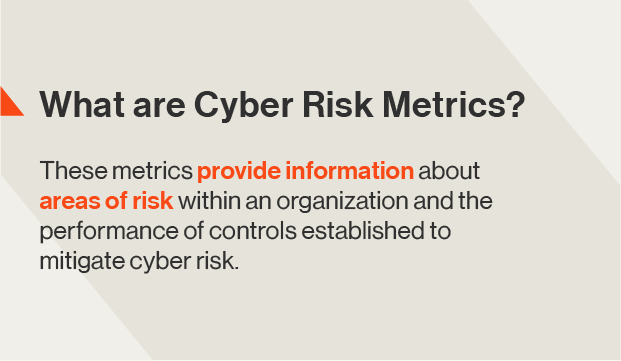
Cyber risk metrics provide information about areas of risk within an organization and the performance of controls established to mitigate risk. Along with cybersecurity analytics, risk metrics enable security teams to determine the effectiveness of security controls and processes over time and identify areas for improvement.

What are Cyber Risk Metrics?

Improving security with cyber risk metrics

Cyber risk metrics are critical to professionals in cyber security and risk management. The right metrics enable security teams to identify risk and establish controls to mitigate it. Metrics also allow organizations to measure the success of cybersecurity programs over time and take action to improve them.

Too often, however, the cyber risk metrics or cloud security metrics that organizations rely on are either overly complex or too vague to facilitate data-driven conversations around cyber risk. Many metrics are presented without context, making it impossible for security teams to rely on this data when prioritizing efforts and investments.

Bitsight can help. Bitsight Security Ratings use externally observable and verifiable data to provide an instantaneous, point-in-time snapshot of an organization’ s overall security posture. By continuously monitoring the security performance of their organization and the security posture of vendors, cyber risk professionals can create cybersecurity plans, track progress over time, and improve their overall security performance.

The benefits of Security Ratings for cyber risk metrics

With Bitsight Security Ratings, organizations can:

  • Benchmark security performance against industry peers to better prioritize security actions and investments and to communicate KPIs to boards and executives more clearly.
  • Measure and mitigate third-party risk with continuous security monitoring that can easily scale to accommodate business growth.
  • Make security risk decisions with greater speed and effectiveness through alerts, reporting, and intelligence. Engage stakeholders and third parties in data-driven conversations about risk and security programs.

Bitsight Security Ratings deliver objective cyber risk metrics

Bitsight Security Ratings use objective, verifiable data to measure an organization’s security performance. Thousands of organizations around the world use Bitsight Security Ratings to deliver cyber risk metrics that help proactively identify, quantify, and manage cyber risk throughout their ecosystem.

In contrast to security assessment tools that conduct periodic scans or evaluate a company’s policies, Bitsight continuously measures security performance based on externally observable data. Bitsight ratings are based on evidence of compromised systems, security diligence, user behavior, and data breaches within an organization. This data-driven, outside-in approach requires no questionnaires to be completed and no information to be provided by an organization. With cyber risk monitoring and daily Security Ratings from Bitsight, organizations have the cyber risk metrics they need to seamlessly identify and measure risk and security performance.

The benefits for cyber risk management

Bitsight for Third-Party Risk Management provides risk managers with:

  • A trusted view of third-party risk. Rather than relying on yearly assessments and security information provided by vendors, risk managers can trust Bitsight’s continuous monitoring capabilities to provide an objective view of each vendor’s security status.
  • Objective and verifiable information. Bitsight Security Ratings are based on objective, verifiable data and have been proven to correlate with a risk of data breaches. If they remain unchanged, a company’s overall Bitsight rating and its grades in given risk categories can reliably predict future security performance. With this information, organizations can protect against vendors who have a higher likelihood of experiencing a cyberattack.
  • Customized monitoring options. The ability to select the best level of continuous monitoring for each vendor promotes efficiency without overspending on cyber risk management efforts.
  • Tools to respond to vendors’ security incidents. When a new incident occurs or a vulnerability is detected, Bitsight not only alerts the organization but enables collaboration with vendors to quickly and efficiently remediate the issue.

Why choose Bitsight?

An industry-leading solution

Bitsight is the world’s leading provider of cyber risk intelligence, transforming how security leaders manage and mitigate risk. Leveraging the most comprehensive external data and analytics, Bitsight empowers organizations to make confident, data-backed decisions and equips security and compliance teams from over 3,300 organizations across 70+ countries with the tools to proactively detect exposures and take immediate action to protect their enterprises and supply chains.

Bitsight customers include 38% of Fortune 500 companies, 4 of the top 5 investment banks, and 180+ government agencies and quasi-governmental authorities, including U.S. and global financial regulators.

Extensive visibility

Bitsight operates one of the largest risk datasets in the world. Leveraging over 10 years of experience collecting, attributing, and assessing risk across millions of entities, we combine the power of AI with the curation of technical researchers to unlock an unparalleled view of your organization. Bitsight offers more complete visibility into important risk areas such as botnets, mobile apps, IoT systems, and more. Our cyber data collection and scanning capabilities include:

  • 40 million+ monitored entities
  • 540 billion+ cyber events in our data lake
  • 4 billion+ routable IP addresses 
  • 500 million+ domains monitored
  • 400 billion+ events ingested daily
  • 12+ months of historical data

Superior analytics

Bitsight offers a full analytics suite that addresses the challenges of peer comparison, digital risk exposure, and future performance.

Ratings validation

Bitsight is the only rating solution with third-party validation of correlation to breach from AIR Worldwide and IHS Markit.

Quantifiable outcomes

Bitsight drives proven ROI with significant operational efficiency and risk reduction outcomes.

Prioritization of risk vectors

Bitsight incorporates the criticality of risk vectors in to calculation of Security Ratings, highlighting risk in a more diversified way to ensure the most critical assets and vulnerabilities are ranked higher.

FAQs: What are cyber risk metrics?

security ratings snapshot example

Request a free cyber risk report for your company to find the gaps in your security program and how you compare to others in your industry.