What is a cybersecurity executive summary?
A cybersecurity executive summary appears at the beginning of a report from security and risk teams and summarizes the most pressing issues concerning the security posture and risk profile of the organization. For example, a cybersecurity executive summary may include key findings as well as summaries of incidents and threats along with recommendations for remediation, programs, and initiatives. A cybersecurity executive summary might include updates on concerning risk vectors from prior reporting cycles.
Drafting a cybersecurity executive summary
Reporting on the performance of cyber risk and security programs is critical to avoiding breaches, learning from prior performance, and mitigating risk. Effective communication and decision making between different levels of an organization – from the practitioners and managers on the ground to the C-suite and the Board – can be the difference between keeping systems secure and suffering a massive incident.
However, too many security and risk professionals make mistake of providing information that’s too technical, too detailed, or without context. These reports can be indecipherable for readers who lack a technical background, preventing security leaders from engaging in the clear communication around risk and security programs that’s required to keep the organization safe.
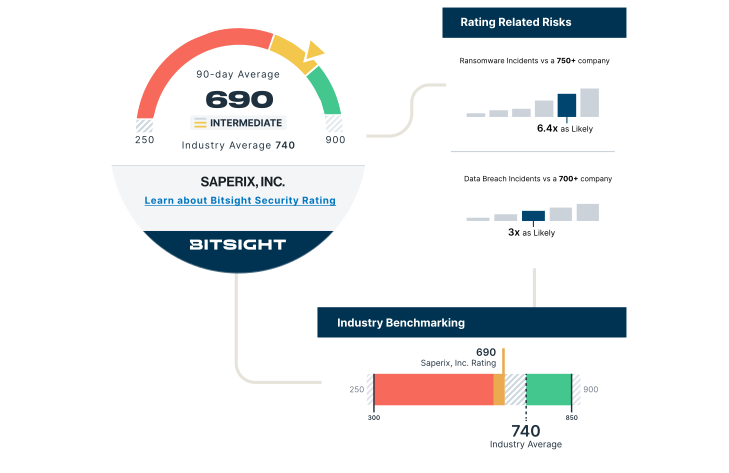
An effective report should capture the highest risk items in a cybersecurity executive summary. For example, aspects of a security program that are significantly underperforming and adding unacceptable risk to the business should be front and center. Effective communications may also include a cybersecurity KPI dashboard that summarizes key findings and recommendations, contextualizing them with risk scores that help the reader understand the severity of risks and the importance of remediation efforts.
As the world’s leading Security Ratings platform, Bitsight provides the tools to accurately assess risk and security performance of an organizations network, as well as their vendors’ risk. The Bitsight Security Ratings platform also includes solutions that can streamline cyber security presentation and reporting, providing templates and examples of cybersecurity executive summaries that help users deliver the most pressing risk information quickly and easily.
Example template
An effective cyber security executive summary includes several essential sections.
Key findings
Every cybersecurity report should begin up front with a summary of the most critical findings and action items in non-technical language that every executive and board member can understand. Key findings can also include security ratings that provide external insight into the organization’s security performance.
Monitoring summary
This section should outline what was monitored for the report, including the number and locations of monitored servers, devices, and workstations, and the extent to which the organization’s endpoints where assessed. Parts of the IT environment that weren’t monitored should also be mentioned, to clearly identify the scope of the report.
Incident summary
It’s helpful to include a summary of the number of incidents detected and resolved in the cyber executive summary. Depending on the audience, you can provide a breakdown of incidents by type, target, and severity, along with metrics such as the Mean Time to Detect (MTTD) and Mean Time to Resolve (MTTR).
Threat summary
In this part of the cyber executive summary, examples and details of the most severe threats faced by the organization can help the reader understand the context of cybersecurity concerns and recommendations. It’s helpful for readers to know about emerging malware trends and recommended actions for stopping them. The threat summary can also include overall or specific levels of financial risk your program is subject to based on the vulnerabilities present.
Recommendations
Recommendations – and the cost of implementing them, if possible – comprise the final section of the cybersecurity executive summary. For example, if a large amount of malware is entering your organization through phishing emails, the recommendations in this section might include stricter enforcement of policies across departments and security awareness training for employees.
What is risk-based reporting?
Risk-based reporting provides insight and analysis into security risks, delivering findings in context that help the recipient understand the role that the data plays in the overall risk landscape of the organization. Findings are often assigned a risk score, and the highest risk items are typically highlighted front and center in the report, often in the cybersecurity executive summary, for example.