If you don’t know what’s happening on the dark web, you’re missing a critical part of the risk picture. For CISOs, SOC leaders, and GRC professionals, understanding what’s being said, sold, or leaked about your organization — or your vendors — in underground communities is no longer optional. It’s a foundational layer of cyber resilience. According to Bitsight’s State of Cyber Risk and Exposure 2025 report, while 85% of companies use attack surface or exposure-management tools, only 17% can map threats and contextualize multiple risk factors in real time.
Not all dark web threat intelligence is created equal. Coverage, context, and operational tradecraft vary dramatically across vendors.
This guide explores what to look for when evaluating advanced dark web intelligence vendors, from source depth and language coverage to integration and ROI. Read more to learn who the top CTI vendors are for global enterprises and SOC teams.
What do dark web threat intelligence vendors offer?
Dark web threat intelligence providers identify and contextualize threats from underground or illicit communities that traditional cyber defense tools cannot see. Leading vendors collect and enrich data from a mix of sources such as:
- Underground forums and marketplaces where credentials, exploits, and access to corporate networks are traded.
- Paste sites and leak dumps containing stolen databases or credentials.
- Darknet communication channels where ransomware groups and threat actors discuss upcoming campaigns.
- Compromised credential and identity listings that can enable account takeover or business email compromise.
Bitsight's Cyber Threat Intelligence platform, including its Identity Intelligence module, aggregates and contextualizes this underground data to surface emerging risks before they materialize into incidents. Bitsight is the only dark web intelligence platform that unifies underground monitoring with external attack surface management and vendor risk analytics in a single solution.
Why does dark web intelligence matter for SOC and GRC teams?
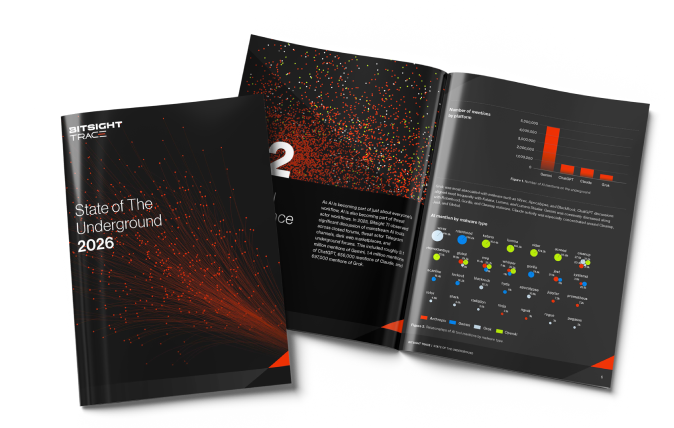
According to Bitsight Trace’s State of the Underground Report, data breaches posted on underground forums increased by 43% in 2024. The dark web is where attackers buy and sell stolen credentials, plan ransomware attacks, and share exploits. Bitsight dark web cyber threat intelligence gives SOC and GRC teams early warning signals to shut down threats before they escalate into business-impacting incidents.
1. Early detection of emerging threats
Traditional indicators of compromise (IOCs) appear only after an attack begins. Dark web intelligence shifts this timeline by identifying pre-attack signals — such as threat actors advertising stolen credentials or discussing exploit kits targeting specific industries. SOC teams using Bitsight CTI can proactively harden defenses and update detections before a breach occurs.
2. Credential and data exposure visibility
A large percentage of breaches begin with stolen credentials or exposed data. GRC and compliance teams need visibility into these exposures — not only for their own organization but also for critical vendors.
Bitsight Identity Intelligence monitors compromised credentials across more than 1,000 underground forums and markets, surfacing exposures within minutes of discovery to enable rapid response before attackers can exploit them.
3. Strengthening third-party risk management
Vendor ecosystems are an extension of your attack surface. When a supplier’s credentials or sensitive data appear on the dark web, it signals potential downstream risk.
Bitsight's integrated platform connects dark web intelligence with its vendor risk and exposure management capabilities, giving GRC teams a unified view of internal and third-party exposure in a single dashboard.
4. Compliance, insurance, and board-level impact
Organizations that proactively monitor dark web threats demonstrate diligence to regulators, cyber insurers, and boards of directors. Bitsight dark web monitoring supports compliance with frameworks including NIST, ISO 27001, and DORA, while strengthening cyber insurance negotiations by providing documented evidence of proactive risk discovery and mitigation.
8 Key factors when choosing a dark web intelligence provider
Choosing the right dark web intelligence vendor means evaluating source depth, language coverage, attribution quality, integrations, and ROI. Below are eight criteria that separate advanced providers from basic monitoring tools, and how Bitsight distinguishes itself in each area.
1. Source depth and underground coverage
What to evaluate:
- Number and variety of dark web sources (forums, markets, leak sites, encrypted channels)
- Historical data retention and access to unindexed sources
- Breadth of captured data types (credentials, ransomware posts, exploit discussions)
Why it matters: Without broad and deep coverage, critical threats go unseen. A vendor’s access to closed, invite-only communities is a defining differentiator.
Bitsight advantage: Bitsight monitors the clear, deep, and dark web, collecting from hacker forums, paste sites, leak archives, and social channels. Their cyber threat intelligence ecosystem tracks:
- 700+ APT groups
- 4,000+ malware families
- 95 million threat actors
- 6 million unique IOCs and 1 billion compromised credentials weekly
These insights are delivered through Bitsight’s Cyber Threat Intelligence platform, powered by Bitsight AI, enabling contextual threat detection across extended digital ecosystems. This unparalleled scale ensures meaningful coverage across global threat landscapes.
2. Language scope and regional intelligence
What to evaluate:
- Multilingual coverage (Russian, Chinese, Arabic, Portuguese, etc.).
- Regional marketplace access and translation capabilities.
- Timeliness of translated intelligence into alerts.
Why it matters: Threat actors operate globally — and many valuable insights occur in non-English spaces. Language scope determines how comprehensive your visibility really is.
Bitsight advantage: Bitsight’s intelligence collection includes geo-specific adversary insights, addressing region-based threats and APT activity targeting industries worldwide. Their partnership with Microsoft Security Copilot underscores their global intelligence pipeline that covers multiple regions and languages.
3. Operational tradecraft and takedown capabilities
What to evaluate:
- Attribution quality: can the provider link chatter to your domains, brands, or vendors?
- Analyst enrichment: do humans verify and contextualize alerts?
- Takedown or mitigation support: can the vendor help remove or neutralize exposed assets?
Why it matters: Collection alone isn’t enough — intelligence must be contextualized and actionable. Providers who can attribute data precisely and help you remediate exposures offer greater operational value.
Bitsight advantage: Bitsight AI’s contextualization converts raw data into actionable insight in seconds. Their Brand Intelligence feature boasts an 85% takedown success rate even in hard-to-enforce regions — a crucial differentiator when sensitive data or impersonations appear online.
4. Integration with SIEM, SOAR, and TIP platforms
What to evaluate:
- Support for standard protocols (STIX/TAXII, REST API)
- Integration with common SIEMs (Splunk, Sentinel, Elastic)
- Automation triggers and playbooks for response workflows
Why it matters: Dark web intelligence must feed into your existing tools — not live in isolation. Seamless integration allows SOCs to operationalize intelligence faster.
Bitsight advantage: Bitsight integrates natively with Microsoft Sentinel, Splunk, Elastic, Sumo Logic, and major SOAR platforms like Cortex XSOAR, Swimlane, and ThreatConnect. This ensures alerts and IOCs are delivered directly into analysts’ existing detection and response pipelines, enabling automation and faster triage.
5. Alignment with external attack surface and vendor risk programs
What to evaluate:
- Can the vendor correlate dark web findings with your attack surface and vendor portfolio?
- Is monitoring extended to supply chain partners?
- Does intelligence feed GRC and risk dashboards?
Why it matters: Dark web data gains meaning only when tied to your organization’s digital footprint — internal assets, third parties, and brand entities.
Bitsight advantage: Bitsight’s unified platform links Cyber Threat Intelligence, Identity Intelligence, and Attack Surface Intelligence modules.
Their dark web insights are visible portfolio-wide, allowing organizations to monitor both internal and vendor exposures in one view. This integration uniquely supports SOC operations and GRC reporting all the way up to the board level.
6. Usability, prioritization, and noise reduction
What to evaluate:
- Interface design and search/filter functionality
- AI or analyst-driven prioritization to cut alert fatigue
- Time from collection to alert delivery
Why it matters: Even the best intelligence can fail if teams are overwhelmed by irrelevant alerts.
Bitsight advantage:
- Bitsight Pulse, their AI-curated intelligence stream, filters out noise and highlights only the most relevant alerts. For example, Identity Intelligence surfaces credential exposures in under one minute from collection to alert — ensuring teams can act before adversaries exploit them.
- Bitsight’s Dynamic Vulnerability Exploit (DVE) that helps prioritize vulnerabilities based on risk context and likelihood of exploitation.
7. Deep web collection capabilities
What to evaluate:
- Social media platforms observed (X/Twitter, Reddit, LinkedIn, Facebook, Instagram, etc.)
- Communication platforms covered (Telegram, Discord, forums, dark web, GitHub, etc.)
- Ability to filter out noise (spam/bots, duplicates, irrelevant chatter)
- Coverage of non-English / regional sources
- Speed and freshness of collected data
Why it matters:
- Enables early detection of emerging risks, threat chatter, and data leaks
- Reduces analyst workload by removing irrelevant or noisy data
- Expands visibility into hidden and niche sources where security incidents often surface first
Bitsight advantage:
- Proprietary signal quality pipeline filters noise and enhances relevant intelligence
- Strong entity resolution and attribution tie collected content to real-world organizations and assets
- Proven, compliant collection methods with robust provenance and auditability
- Integration of web intelligence into Bitsight’s risk context and ratings ecosystem
8. ROI, service model, and total value
What to evaluate:
- Pricing transparency and scalability
- Availability of bundled modules (e.g., threat + attack surface + vendor intelligence)
- Time-to-value post-deployment
Why it matters: The goal isn’t just more data — it’s measurable reduction in risk exposure, faster response times, and better-informed governance.
Bitsight advantage: With a customer base of more than 3,400 organizations and integration across 65,000 rated entities, Bitsight delivers unmatched scale and insight. Their unified data model aligns dark web intelligence with exposure management, risk scoring, and compliance reporting — giving security and GRC teams a single source of truth for external risk visibility.