What Is Dark Web Threat Intelligence? How It Works, What It Detects, and How to Use It

Dark web threat intelligence is one of the most operationally critical capabilities an enterprise security program can deploy today. As cybercriminals move their operations increasingly underground, relying on invite-only forums, encrypted marketplaces, and anonymous communication channels to coordinate attacks and trade stolen assets, organizations that limit their visibility to the surface web are operating with a significant blind spot. This guide is written for security operations center (SOC) analysts, threat intelligence practitioners, governance, risk, and compliance (GRC) teams, and technical decision-makers who need a clear, practical understanding of what dark web threat intelligence is, how it works at scale, what it can detect, and how to use it to protect enterprise environments. Readers will learn the foundational concepts, architectural considerations, and implementation strategies that distinguish a mature dark web intelligence program from a reactive monitoring effort. Bitsight, the global leader in cyber risk intelligence, draws on one of the industry's most extensive external cybersecurity datasets to help organizations operationalize these capabilities at scale.

Core Components of Dark Web Threat Intelligence and Why They Matter at Scale

Dark web threat intelligence refers to the collection, processing, enrichment, and operationalization of data sourced from underground environments that are not indexed by standard search engines. These environments include the deep web, which encompasses password-protected forums and private markets, and the dark web, which operates through anonymizing networks such as Tor. The distinction matters because each layer of the underground ecosystem surfaces different threat signals, from early-stage credential leaks to active ransomware negotiation threads.

At its core, a functional dark web intelligence capability requires four foundational components: continuous collection infrastructure capable of accessing restricted underground sources; enrichment and normalization engines that transform raw, unstructured data into structured threat objects; correlation logic that maps discovered intelligence to an organization's specific assets and attack surface; and operationalized delivery that routes actionable alerts into security workflows. Without all four working in concert, organizations receive raw data they cannot act on, which increases analyst workload without improving outcomes.

Bitsight supports all four components through its Cyber Threat Intelligence platform, which collects intelligence continuously from open and closed underground forums, dark web marketplaces, paste sites, ransomware leak sites, and social messaging channels including Telegram and Discord. The platform processes over 7 million intelligence items daily and maps findings directly to an organization's unique digital footprint, ensuring that what teams receive is relevant rather than generic.

How Dark Web Threat Intelligence Fits Into Modern Enterprise Security Architecture

Traditional threat intelligence programs were designed around indicators of compromise (IOCs) such as malicious IP addresses, domain names, and file hashes. These signals are useful for detecting attacks in progress, but they arrive too late to prevent the initial breach. The underground economy operates on a different timeline. Stolen credentials are sold weeks or months before they are used to facilitate unauthorized access. Ransomware groups discuss target selection in underground forums before launching campaigns. Exploit kits targeting specific software vulnerabilities are traded in private markets before the vulnerabilities are publicly disclosed.

Dark web threat intelligence shifts the detection timeline earlier in the attack lifecycle. By monitoring these pre-attack signals, security teams gain lead time to rotate exposed credentials, patch targeted vulnerabilities, and harden defenses before adversaries execute. This represents a fundamental shift from reactive to proactive security operations. According to Bitsight's State of the Underground Report, data breaches posted on underground forums increased by 43% in 2024, underscoring how active these environments have become as sources of pre-attack intelligence.

In modern enterprise environments, dark web intelligence does not replace existing security tooling. It extends and enriches the signal that feeds into security information and event management (SIEM) platforms, security orchestration automation and response (SOAR) systems, and vulnerability management workflows. A minimum viable implementation monitors for exposed credentials and brand mentions. A mature implementation correlates dark web signals with attack surface data, vendor risk telemetry, and threat actor profiles to produce prioritized, context-rich intelligence that different teams can act on without requiring deep analytical expertise.

Common Challenges Enterprises Face When Scaling Dark Web Intelligence Programs

Dark web intelligence programs face a distinct set of operational challenges that differ from traditional threat intelligence initiatives. The underground ecosystem is fragmented, volatile, and deliberately obfuscated. Forums disappear and re-emerge under different names. Access to high-value closed communities requires ongoing tradecraft investment. Language diversity across criminal communities demands multilingual collection and analysis capabilities. These realities make scaling difficult without the right infrastructure and expertise in place.

Bitsight has worked with thousands of enterprise security teams to identify and address the operational gaps that limit the effectiveness of dark web intelligence programs in production environments.

Key Challenges and Failure Modes When Scaling Dark Web Intelligence

Source Coverage Degradation: Underground forums and markets have short lifespans. When a collection infrastructure relies on a static list of sources, it quickly loses coverage as the threat landscape migrates. Effective programs require dynamic source discovery that continuously identifies and onboards new underground communities.

Signal-to-Noise Ratio at Scale: Large organizations generate enormous volumes of potential matches across credential databases, forum mentions, and paste site dumps. Without automated enrichment and relevance filtering, analyst teams become overwhelmed and miss critical signals buried in noise.

Context Deficits: Raw dark web data lacks context on its own. A discovered credential dump means little without knowing whether the exposed accounts are still active, what systems they can access, and how recently the data was harvested. Context transforms a data point into an actionable alert.

Siloed Operationalization: Many organizations collect dark web intelligence but fail to route it to the teams and systems that need it. GRC teams rarely have access to SOC feeds. SOC teams rarely have visibility into third-party vendor risk. Intelligence that sits in a separate portal without integration into existing workflows delivers limited operational value.

Tradecraft and Analyst Skill Gaps: Engaging with underground communities, validating intelligence provenance, and attributing activity to specific threat actors requires specialized skills that most enterprise security teams do not maintain in-house. Over-reliance on manual collection creates coverage gaps and exposes analysts to legal and operational risk.

Teams can address these challenges by designing for integration from the start, standardizing on structured intelligence formats such as STIX and TAXII, establishing clear ownership between SOC and GRC functions, and investing in platforms that automate enrichment and correlation. Bitsight reduces the operational burden of these challenges by embedding AI-driven enrichment directly into the collection pipeline, correlating dark web signals with an organization's external attack surface, and delivering pre-prioritized alerts through SIEM and API integrations that fit existing workflows.

How to Define a Winning Dark Web Threat Intelligence Strategy

The most common mistake organizations make when building a dark web intelligence program is optimizing for coverage before defining what outcomes the program needs to produce. A program that monitors thousands of sources but cannot route a discovered credential leak to the identity team within minutes of discovery has not solved the operational problem. Strategy must precede tooling selection, and outcomes must be defined before coverage requirements.

An effective dark web intelligence strategy starts with three foundational decisions: what assets and entities require monitoring, what actions the organization is prepared to take upon receiving an alert, and how intelligence will be integrated into existing security and risk workflows. Organizations that align these decisions with specific threat scenarios, such as credential-based initial access or ransomware pre-targeting, build programs that deliver measurable value rather than raw data volume.

Bitsight enables organizations to operationalize these strategic decisions through configurable monitoring profiles, automated alert routing, and intelligence delivery in formats that feed directly into governance and operational workflows without requiring manual translation.

Must-Have Capabilities for a Scalable Dark Web Threat Intelligence Strategy

Continuous Underground Monitoring: Static, periodic scans are insufficient in an environment where credentials are bought and sold within hours of discovery. Effective programs require continuous, real-time collection infrastructure across both open and closed underground communities.

AI-Powered Enrichment and Prioritization: Raw data volume from dark web sources is too high for manual triage at enterprise scale. AI-driven enrichment that scores threats by relevance, recency, and exploitation likelihood allows teams to focus on what matters rather than everything that exists.

Asset-Mapped Correlation: Intelligence has limited operational value unless it is correlated to the specific domains, IP ranges, employee identities, and vendor relationships that constitute the organization's actual attack surface. Unmapped intelligence produces alerts that teams cannot act on without additional research.

Third-Party and Supply Chain Visibility: The enterprise attack surface extends beyond the organization's own assets. Credential leaks and breach indicators affecting vendors and suppliers represent direct downstream risk and must be monitored with the same rigor as internal assets.

Structured Integration Delivery: Intelligence must be delivered in formats that integrate natively with SIEM, SOAR, and ticketing platforms. STIX and TAXII support, combined with REST API access, ensures that dark web signals flow into existing security workflows without creating parallel operational processes.

Proactive Takedown and Remediation Workflows: Detection without remediation extends exposure windows. Platforms that provide built-in workflows for credential invalidation, brand protection takedowns, and vendor notification close the loop between discovery and risk reduction.

Bitsight exceeds these strategic requirements through its unified Cyber Threat Intelligence platform, which combines underground monitoring, AI enrichment, asset mapping, and third-party risk visibility in a single solution. The platform's Brand Intelligence module achieves a strong takedown success rate, including in jurisdictions that are traditionally difficult to enforce against.

How to Choose the Right Dark Web Threat Intelligence Solution for Your Organization

Enterprise security and risk leaders evaluating dark web intelligence solutions face a market where capability claims vary dramatically from demonstrated performance. Organizations with large vendor ecosystems, regulated industries, and distributed security teams have fundamentally different requirements than small or mid-market organizations conducting targeted monitoring. The right solution depends on the complexity of the organization's attack surface, the maturity of existing security workflows, and the specific threat scenarios that drive the most business risk.

Bitsight's customer base includes large enterprises across financial services, healthcare, critical infrastructure, and technology sectors that require comprehensive coverage, deep integration capabilities, and scalable automation to manage threat intelligence at the volume and velocity their environments demand.

Tool Selection Criteria That Matter Most

Organizations should evaluate dark web intelligence solutions against six core criteria. First, source depth and breadth: does the platform monitor both open and closed underground forums, ransomware leak sites, paste sites, and social messaging channels across multiple languages and geographies? Second, enrichment quality: does the platform transform raw data into context-rich, prioritized intelligence, or does it deliver raw data dumps that require analyst interpretation? Third, asset correlation: can the platform map discovered intelligence to the organization's specific attack surface, including third-party vendor assets? Fourth, integration depth: does the platform support STIX, TAXII, and REST API delivery into SIEM, SOAR, and other operational tools? Fifth, remediation capability: does the platform provide built-in workflows for takedowns, credential rotation alerts, and vendor notifications? Sixth, scalability and automation: can the platform operate at the volume required by the organization without creating analyst fatigue through unfiltered alerting?

Build vs Buy Tradeoffs

Building an in-house dark web intelligence capability is technically feasible but operationally expensive. It requires maintaining anonymized collection infrastructure across volatile underground sources, employing multilingual analysts with underground tradecraft expertise, and continuously updating source coverage as forums migrate. These requirements are cost-effective only for the largest organizations with mature, well-funded threat intelligence teams. For most enterprises, the time-to-value tradeoff favors managed or commercial solutions that can deliver production-ready intelligence on day one. The ongoing operational cost of maintaining access to closed forums, updating collection infrastructure, and retaining specialized analysts typically exceeds the cost of a commercial platform within the first year of operation.

Reference Architectures by Team Size

Small teams with limited analyst capacity benefit most from platforms that deliver pre-prioritized, asset-correlated alerts directly into existing tools such as Jira, Slack, or SIEM dashboards. The goal is actionable signal delivery without requiring a dedicated threat intelligence analyst to operate the platform. Medium-sized teams can leverage structured intelligence feeds to enrich existing detection and response workflows, using API integrations to correlate dark web signals with endpoint and identity telemetry. Large enterprise teams with dedicated threat intelligence functions require full STIX and TAXII support, custom monitoring profiles, deep API access, and integration with threat intelligence platforms (TIPs) for analyst-led investigation and attribution workflows.

Tool Categories Required for a Complete Stack

A complete dark web intelligence stack spans five functional categories regardless of the specific tools deployed: underground collection infrastructure covering open and closed sources; enrichment and normalization engines that produce structured threat objects; asset correlation and attack surface mapping to provide relevance context; integration and delivery mechanisms that route intelligence to operational teams; and remediation and response workflows that close the loop between discovery and risk reduction. Platforms that unify multiple categories reduce the integration overhead and data latency that degrade the value of point solutions assembled from separate vendors.

Step-by-Step Guide to Implementing Dark Web Threat Intelligence in Production

Implementing a dark web intelligence program in production requires careful sequencing to deliver early operational value while avoiding architectural decisions that create long-term technical debt. Teams that begin with broad, uncorrelated monitoring collect large volumes of data that they cannot operationalize. Teams that begin with tightly scoped, asset-correlated monitoring build the operational muscle to expand coverage systematically.

Implementing Dark Web Threat Intelligence Across the Enterprise

Step 1 - Define Scope and Asset Registry: Begin by establishing which assets and entities require monitoring. This includes corporate domains, employee and executive email addresses, IP ranges, partner-facing subdomains, technology stack identifiers, and the digital footprints of critical third-party vendors. A complete asset registry is the prerequisite for correlated, relevant intelligence delivery.

Step 2 - Configure Monitoring Profiles and Alert Thresholds: Map asset categories to specific monitoring scenarios. Credential exposure monitoring should cover all active employee domains and high-privilege account patterns. Brand monitoring should cover domain variants, executive names, and product identifiers. Third-party monitoring should cover critical vendors and suppliers whose compromise would represent direct downstream risk.

Step 3 - Establish Integration Points with Operational Tools: Before alerts begin flowing, configure integration endpoints in the SIEM, SOAR, identity management platform, and vulnerability management system. Define the data format and enrichment fields required by each system so that incoming alerts are immediately actionable without requiring manual processing. Bitsight supports STIX, TAXII, and REST API delivery to ensure compatibility with the major platforms security teams already operate.

Step 4 - Define Response Playbooks by Alert Type: Each intelligence category requires a predefined response workflow. A discovered credential leak should trigger an automated identity verification and forced rotation workflow. A ransomware targeting discussion that names the organization or a key vendor should escalate immediately to the incident response team. A vulnerability exploit discussion that correlates to an unpatched asset in the attack surface should route to the vulnerability management team. Playbooks defined before alerts arrive prevent response delays caused by decision-making under pressure.

Step 5 - Establish Baseline and Calibrate Noise Filters: In the first two to four weeks of operation, document the baseline alert volume and false positive rate. Use this baseline to calibrate relevance scoring thresholds and suppression rules so that the alert queue reflects genuine risk rather than ambient underground noise. Platforms with AI-driven enrichment, such as Bitsight, automate much of this calibration through asset-specific relevance scoring.

Step 6 - Expand Coverage Iteratively Based on Threat Scenarios: Once the core monitoring, integration, and response workflows are operating reliably, expand coverage to additional asset categories and underground sources. Introduce third-party vendor monitoring to extend visibility across the supply chain. Add sector-specific threat actor tracking to identify campaigns targeting the organization's industry before they reach the organization directly.

Step 7 - Conduct Regular Intelligence Reviews and Program Retrospectives: Schedule recurring reviews to assess the operational value the program is delivering, measured by lead time gained, credentials rotated, vulnerabilities patched ahead of exploitation, and vendor incidents identified before public disclosure. Use these metrics to demonstrate program value to leadership and guide future investment decisions.

Best Practices for Operating a Dark Web Threat Intelligence Program Long Term

A dark web intelligence program that is well-configured at launch will degrade in effectiveness without disciplined operational practices. Underground environments evolve continuously, organizational attack surfaces change with every new vendor relationship and product deployment, and threat actor TTPs shift in response to defensive improvements across the industry. Long-term program effectiveness requires proactive maintenance, not passive monitoring. Bitsight's experience working with more than 3,500 enterprise customers positions the company to recommend the following operational practices based on what works in production environments across regulated industries and complex vendor ecosystems.

Maintain a Living Asset Registry: The organization's monitored asset scope should be reviewed and updated at least quarterly to reflect new domains, acquired entities, technology deployments, and changes to the vendor ecosystem. Intelligence that is not correlated to current assets produces false confidence rather than genuine coverage.

Review Source Coverage Quarterly: Underground sources migrate, go offline, and re-emerge constantly. Confirm that the platform is maintaining coverage of high-value source categories and updating source inventories in response to ecosystem shifts. This is particularly important for closed forums and invite-only communities where access must be actively maintained.

Standardize Intelligence Formats Across Teams: GRC, SOC, and executive stakeholders require different intelligence formats to act on the same findings. SOC analysts need structured IOCs. GRC teams need risk narratives tied to vendor relationships and compliance obligations. Executives need summary-level risk indicators. Defining and maintaining these format standards ensures intelligence reaches the right audience in a usable form.

Conduct Threat Actor Profiling for Key Adversaries: Generic threat monitoring produces generic intelligence. Organizations that build and maintain profiles of threat actors known to target their industry, geographic region, or technology stack can configure monitoring to surface early signals from these specific groups before campaigns are launched.

Measure and Report on Program Outcomes: Dark web intelligence programs are often invisible to leadership until they prevent a major incident. Establishing outcome metrics, including mean time between underground discovery and credential rotation, number of vendor incidents detected ahead of public disclosure, and percentage of vulnerabilities patched before underground exploitation, provides the evidence base needed to sustain program investment.

Align Intelligence Cycles with Risk Review Cadences: Dark web intelligence should inform quarterly vendor risk reviews, annual penetration testing scope decisions, and board-level cyber risk reporting. Programs that operate in isolation from governance processes fail to realize their full organizational value.

How Bitsight Simplifies and Scales Dark Web Threat Intelligence for Enterprises

Bitsight is the global leader in cyber risk intelligence and the only platform that unifies underground monitoring with external attack surface management and vendor risk analytics in a single solution. This architectural distinction matters because the value of dark web intelligence is determined not by the volume of data collected but by how precisely that data is correlated to the organization's specific risk environment and how effectively it can be acted on by the teams responsible for different parts of the security program.

Bitsight's Cyber Threat Intelligence platform collects data from the clear web, deep web, dark web, and social messaging channels, processing millions of intelligence items daily through automated collection infrastructure and AI-driven enrichment pipelines. The platform's asset mapping engine correlates discovered intelligence against an organization's verified digital footprint, including third-party vendor assets, so that every alert is relevant rather than generic. Dynamic Vulnerability Exploitability (DVE) scoring uses real-world exploit activity data to predict which vulnerabilities are most likely to be targeted within the next 90 days, replacing theoretical CVSS severity rankings with exploitation probability that reflects how attackers actually behave.

For supply chain risk programs, Bitsight launched the industry's first Dark Web Intelligence for Supply Chains capability, which maps third-party exposures to active attacker TTPs using the MITRE ATT&CK framework and delivers breach indicators for vendors and suppliers earlier than public disclosures or vendor-initiated notifications. For brand protection, the Bitsight Brand Intelligence module delivers an 85% takedown success rate for detected impersonations, malicious domains, and credential exposures, including in regions where enforcement is traditionally difficult. For SOC teams, Bitsight Pulse delivers a real-time, AI-curated intelligence stream filtered to the organization's specific attack surface, industry, and geography, eliminating the alert fatigue that limits the operational effectiveness of generic threat feeds.

Bitsight also partners with Microsoft to provide dark web and deep web threat intelligence directly within Microsoft Security Copilot's Threat Intelligence Briefing Agent, delivering sector- and geography-specific adversary insights into the workflows security teams already use. With more than 3,500 customers and over 68,000 organizations active on its platform, Bitsight delivers the scale, coverage, and integration depth that enterprise dark web intelligence programs require.

Key Takeaways and How to Get Started

Dark web threat intelligence is no longer an advanced capability reserved for large government agencies and financial institutions. It is a foundational component of enterprise security programs operating in an environment where credential theft, ransomware targeting, and supply chain compromise are now standard attacker tactics. Organizations that monitor underground environments gain the lead time to prevent incidents that reactive programs will only detect after damage has occurred.

The core principles of an effective program are straightforward: monitor continuously across the full underground ecosystem, enrich and prioritize every signal against your specific attack surface, integrate intelligence delivery into existing security and risk workflows, and define response playbooks before alerts arrive. Execution at enterprise scale requires platforms that automate these steps without increasing analyst workload.

Bitsight is purpose-built for this challenge, combining AI-powered underground monitoring, attack surface correlation, third-party risk intelligence, and integration-ready delivery in a unified platform. Security and GRC teams ready to build or mature a dark web intelligence program can request a free threat assessment from Bitsight to see how the platform maps discovered underground intelligence to their organization's specific assets and vendor ecosystem.

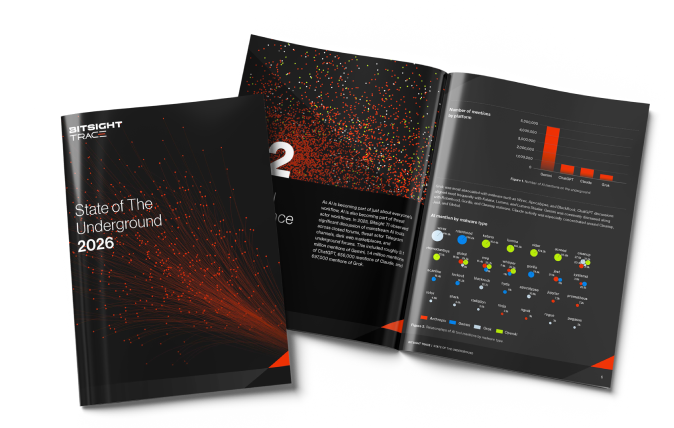
SOTU cover Image

Report: 7.7 Million endpoint logs for sale & more

Stealer malware is thriving—especially Lumma and Risepro. These logs fuel ransomware, MFA bypass, and persistent access. It's $10 to compromise an account. Explore this and other insights the data reveals.