Bitsight Recognized as a Visionary in 2026 Gartner® Magic Quadrant™ for Cyber Threat Intelligence Technologies
Get the report and see why Bitsight was named a Visionary.
Not every threat matters equally to every organization.
A newly discovered APT or ransomware group targeting European automotive manufacturers is definitely worth paying attention to, especially if you’re in that sector. But if you’re a financial services firm in California, it’s probably not an immediate priority.
You might look into it, track its activity, and assess whether it could become relevant. But until that threat starts targeting your sector, geography, or peers, it probably won’t demand the same level of attention as activity already impacting organizations like yours.
That distinction matters. Without sector or geographic context, security teams are left to determine relevance for themselves.
When security teams understand the threat landscape through the lens of their own sector and geography, threat intelligence becomes far more actionable. Instead of asking "what threats exist?", teams can focus on more practical questions:
Sector and geographic context turns threat intelligence into a more focused set of defensive priorities. The challenge is getting that context quickly and consistently.
Organizations typically approach cyber risk from two directions. Internally, they focus on their own environment: vulnerabilities, exposed assets, security gaps, and other first-party risks. Externally, they consume threat intelligence to understand the broader landscape. The problem is that these two views rarely connect.
Security teams are left to bridge the gap themselves, manually correlating threat feeds, vulnerability databases, breach reports, and industry research to figure out which adversaries, techniques, and vulnerabilities are most likely to impact organizations like theirs.
This creates real consequences. Resources get spent mitigating irrelevant threats while higher-priority threats go unaddressed. Teams stay reactive to sector-specific attacks instead of preparing for them in advance. And it becomes difficult to validate whether defenses are actually aligned to the threats most likely to target their industry.
The tools organizations rely on today each play an important role, but none were originally designed to answer the sector-relevance question on their own. Exposure management platforms provide critical visibility into vulnerabilities and assets, though they focus on what you own rather than which external threats are most likely to target your industry. Threat intelligence platforms and feeds deliver valuable adversary and vulnerability data, but connecting that data to a specific sector still requires significant manual effort. And industry reports and breach disclosures help fill in the picture, but keeping up with them at scale is a challenge in itself.
Organizations can see their own exposures. They can see what's happening across the threat landscape. What they struggle to do is connect the two and pinpoint where to focus.
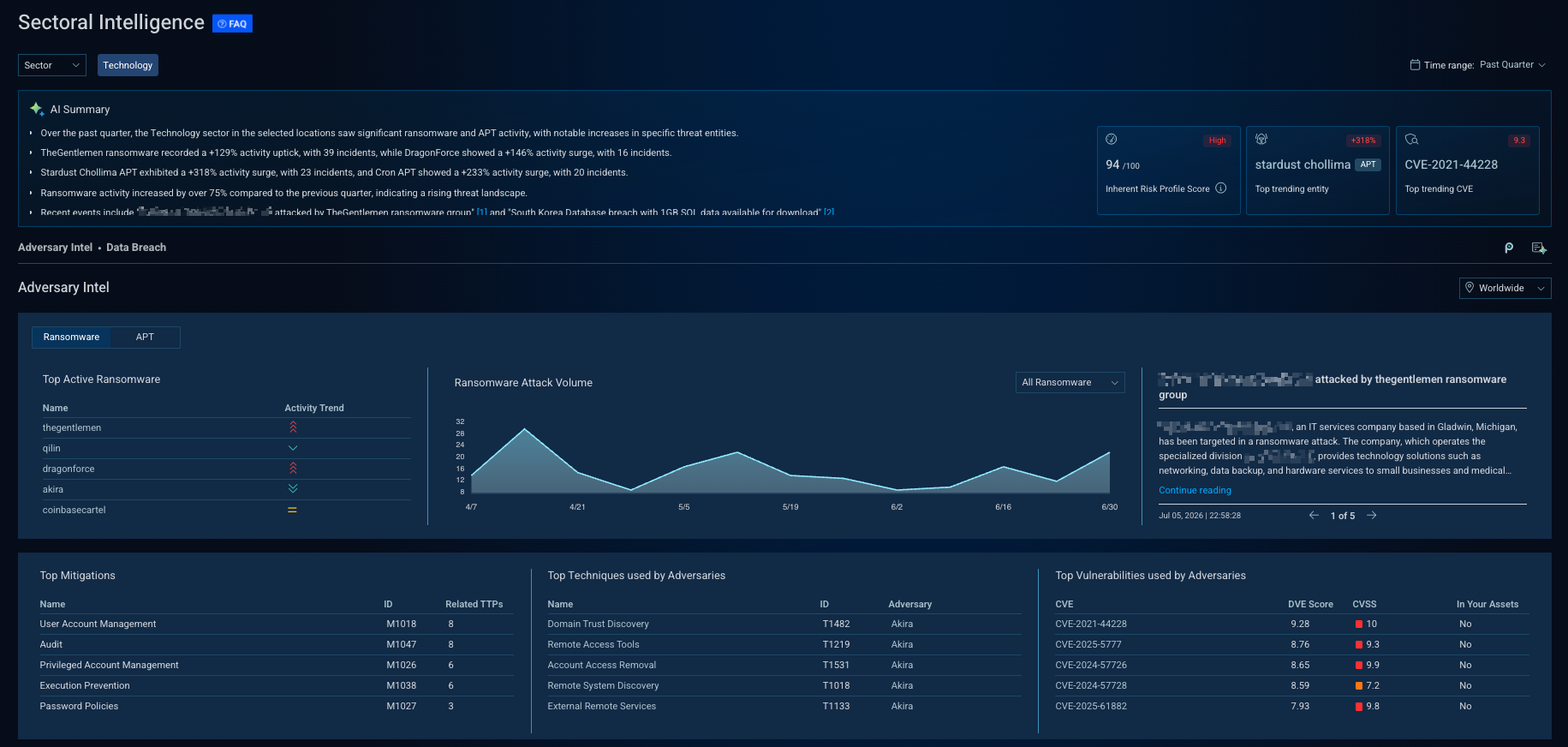
Bitsight Sectoral Intelligence is built to close that gap. It's an industry- and geography-focused threat intelligence capability, available within the Bitsight Threat Intelligence (TI) Investigative Portal, that helps security teams understand the specific threats targeting their sector and act on them.
Rather than presenting a global view and expecting analysts to filter it down, Sectoral Intelligence continuously analyzes adversary activity, attack techniques, vulnerabilities, breach events, and risk indicators across sectors and regions. The result is a focused, contextualized view of what's happening in your corner of the threat landscape, so teams can prioritize defense, remediation, and detection based on the threats most likely to impact their organization.
Sectoral Intelligence helps organizations shift from reactive to threat-informed defense, making sure they have direction on what to focus on next.
When security teams can see which adversaries are actively targeting organizations like theirs, which vulnerabilities are being exploited in their sector, and which attack techniques are trending in their region, they can make better decisions about where to invest, what to remediate first, and how to align detection and response to real-world risk.
This enables organizations to:
The bottom line: Better prioritization, stronger resilience, and greater confidence that resources are focused on the threats that actually matter.
Understanding what is happening across your sector is only the first step. The next is using that intelligence to anticipate how risk is evolving and build a strategy around it.
By analyzing changes in adversary activity, breach patterns, attack techniques, and vulnerabilities, security teams can identify emerging threats earlier and prioritize the actions most likely to reduce risk. Bitsight Threat Intelligence helps teams turn that context into a more proactive, focused security strategy.
Sectoral Intelligence is live in the Bitsight TI Investigative Portal. To see how it can help your organization focus on the threats targeting your sector, request a demo.
Get the report and see why Bitsight was named a Visionary.