Security leaders are under pressure to do more than identify issues. They need to show that security work is reducing real risk.
That’s harder than it should be. Attack surfaces keep expanding, threats keep changing, and many teams are still working through long lists of issues without enough context to know what deserves attention first.
That's where Threat Insights in Bitsight Security Posture Management can make a real difference. By adding threat-informed context to exposure data, security teams can move beyond a static list and start connecting issues to the threat actors, behaviors, and attack patterns most relevant to their environment.
From issues to threat-informed prioritization
The biggest challenge in posture management is not a lack of issues; it’s a lack of context.
Most teams already have visibility into exposures. They can sort by severity, review dashboards, and export reports. What they often can’t answer quickly is the question that matters most: what’s most relevant right now based on how attackers are actually operating?
That gap affects day-to-day remediation and higher-level decision-making. When teams rely too heavily on severity alone, it becomes harder to explain why one issue deserves immediate attention while another can wait.
Threat-informed context helps close that gap by connecting issues to real-world attacker behavior. Instead of looking at an issue only as a technical condition, teams can understand how it maps to tactics, techniques, and procedures associated with active threat groups. They can also add context such as geography, industry targeting, and ransomware activity to better assess relevance.
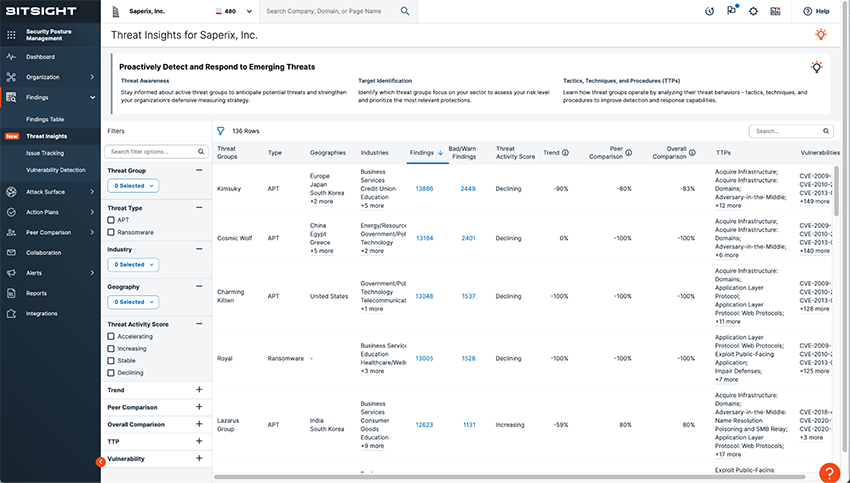
That matters because not every issue deserves the same response. Security teams need a clearer way to focus their time where it will have the greatest impact, not more noise.
What Threat Insights add to the workflow
Threat Insights are most useful when they are part of the investigation and remediation workflow, not another feed analysts have to monitor separately.
When threat context is embedded directly into issues, teams can quickly see which ones are associated with known attacker behaviors, which patterns are becoming more active, and where those patterns overlap with their own environment.
That changes the conversation. Instead of asking only “What is vulnerable?,” teams can ask “Which of these issues align with the threats most relevant to us right now?”
That is a more useful starting point for prioritization.
Why this matters for security leaders
For security leaders, the value goes beyond visibility; now it’s about better decision-making.
Threat-informed context helps leaders understand which threat groups are most relevant to their organization, which behaviors those groups tend to use, and how that should shape remediation priorities. That creates a more practical basis for action than severity scores alone.
It also supports stronger communication with executive stakeholders. Security leaders are often expected to explain not only what the team is fixing, but why those actions matter to business risk and resilience. Threat context makes that explanation more grounded and more credible.
This is especially important because security operations, governance, and risk teams often work from different signals and timelines. Threat-informed prioritization gives them a more consistent frame for deciding what matters, what should happen next, and how to explain progress.