By now, most of us in security are all too familiar with the shrinking exploit window. It's hardly surprising when major, business-disrupting vulnerabilities pop up more frequently. Whenever a critical flaw emerges, security teams usually have to scramble to pinpoint vulnerable systems, gauge their actual risk, and push out patches or network segmentation. Things get chaotic quickly when teams lack a straightforward way to track vendors or keep tabs on contextual threat data.
That’s precisely what played out with the PHP2Shell vulnerability, which brought two distinct timelines into focus: early public chatter that surfaced before PHP officially released its fixes, and an exploitation attempt that Amazon later backdated several days prior. The flaws hit PHP’s request-handling code and could let an unauthenticated attacker execute code remotely. This timeline serves as a sharp reminder that keeping tabs on conversations around core technologies (rather than waiting around for assigned CVE numbers) can buy defenders crucial lead time before official patches land, provided careful timestamp checks keep those early-warning claims rooted in real evidence.
Key takeaways
- Bitsight’s analysis of our threat intelligence data uncovered relevant non-repository discussions of PHP on October 20.
- GitHub entries timestamped October 15–18 in the results we reviewed reflected repository creation dates, not the dates their matching text was added. Because some indexed content cited later advisories and already-patched releases, those dates weren't actually evidence of earlier leak activity.
- Amazon Threat Intelligence later logged an exploitation attempt dated October 17. Even though we can't verify if the attempt succeeded, it shows that threat actors displayed interest in the vulnerability before widespread reporting.
What surfaced before the fixes
PHP2Shell refers to two critical flaws in PHP’s request handling. CVE-2026-109618 involves an out-of-memory condition that can leave request data partially initialized before cleanup, while CVE-2026-109619 involves a stale request state that might be reused after its memory has been freed. PHP confirmed both could enable unauthenticated remote code execution (RCE) on servers handling web requests. The team patched the issues in PHP versions 8.5.12, 8.4.27, 8.3.36, and 8.2.35. On October 20, PHP’s security team announced that fixes would be released on October 21, with 14:00 UTC as the scheduled release time. PHP’s release announcements followed shortly after: PHP 8.5.12 at 14:10 UTC and PHP 8.4.27 at 14:32 UTC. The official release on October 21 made those updates available, leaving defenders with a defined, albeit tight, window to find affected deployments and prepare updates.
When Bitsight dug into our own threat intelligence search_underground_raw collection on October 27, the earliest relevant non-repository records were timestamped October 20. These included:
- Early coverage from BleepingComputer
- An ihonker forum thread at 16:00 UTC
- An X post at 17:04 UTC
- And a watchTowr analysis published at 18:26 UTC (which lined up with watchTowr's public FAQ release date).
PHP’s official patches were scheduled for 14:00 UTC on October 21, and the release announcements followed shortly after, roughly 20 hours after watchTowr’s initial write-up. That modest head start gave proactive security teams a valuable window to map their exposure and prep patch workflows before public disclosure hit full swing.
Telemetry from Amazon’s MadPot honeypot network adds crucial context here. Amazon reported an exploit attempt as early as October 17, several days before any public chatter started. While Amazon couldn't confirm whether the payload would have successfully compromised live production systems, the finding proves that threat actors were actively probing the flaw well before discussions surfaced in underground channels.
Bitsight Research
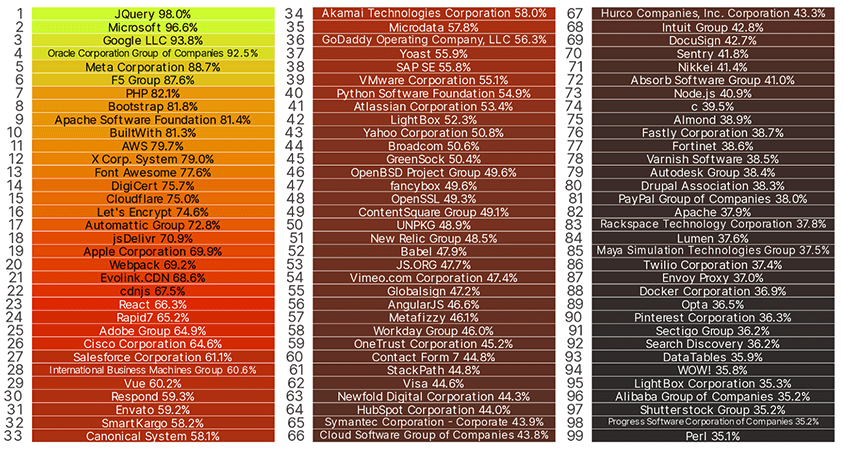
PHP’s reach is easy to underestimate because it sits in the supply chain rather than on the surface. In Bitsight TRACE’s 2025 report on global supply chain risk, PHP ranked seventh among the 99 largest providers by market share at 82.1%. A flaw in a provider that concentrated can reach many organizations at once, including ones that never chose PHP directly. Unlike client-side libraries, PHP runs on the server, where a flaw in its request handling can allow remote code execution (RCE), depending on the vulnerability and configuration. As AI continues to accelerate vulnerability discovery and exploitation, having context about technology dependencies and exposure helps security teams decide which risks need the most attention.
Why some search results looked earlier
Initial CTI queries at Bitsight turned up a few GitHub repositories with timestamps between October 15–18 containing code snippets referencing PHP2Shell, assigned CVEs, or patched PHP releases. However, the repository creation-date field only shows when the repository was created; it does not show when specific text or code commits were added.
Since much of that code explicitly cited PHP’s October 21 advisory and patched releases, we left those dates out of our early-warning timeline. Mistaking repository creation dates for actual publication timestamps can distort threat analysis, giving a false impression of an earlier warning window than the evidence really supports.
This serves as an important lesson for threat analysts: a search result's date stamp might refer to a container record, a repository container, or the text itself. Validating underlying timestamps against the surrounding context is crucial before deciding when an exploit signal actually first appeared.