The PHP security team has announced an emergency security release for Wednesday, October 21, 2026 at 14:00 UTC. It addresses two critical vulnerabilities, both rated CVSS v4.0 9.2. The vulnerabilities are tracked as CVE-2026-109618 and CVE-2026-109619. Both bugs are described as remote code execution issues, meaning an attacker could get their own commands running on a vulnerable server.
The route to disclosure was messy. On October 20, an unverified claim began circulating on social media that an announcement about two PHP vulnerabilities was due on October 22. The message also listed the two reserved CVE IDs, and it spread quickly. PHP then issued its own advance notice and brought the release forward by a day.
Security researchers then moved quickly to test the claims. At least one security firm said it had reproduced CVE-2026-109618 in its lab, and other researchers are reported to have reproduced the flaws as well. That means code execution has reportedly been demonstrated by more than one party before any official fix existed. A leaked exploit tool, known as PHP2Shell, has also been circulating, and the name is now widely used for these two vulnerabilities.
Our continuous internet-wide scans show that only about a third of the PHP instances where we could identify the version run a branch covered by this security update (8.2 through 8.5). The rest are on older branches that did not receive one, and the most common branch by far is PHP 7.4, with more than 2 million observations. The chart shows the 20 most commonly detected branches. Many other PHP deployments are likely exposed but not shown, because they do not expose version information.
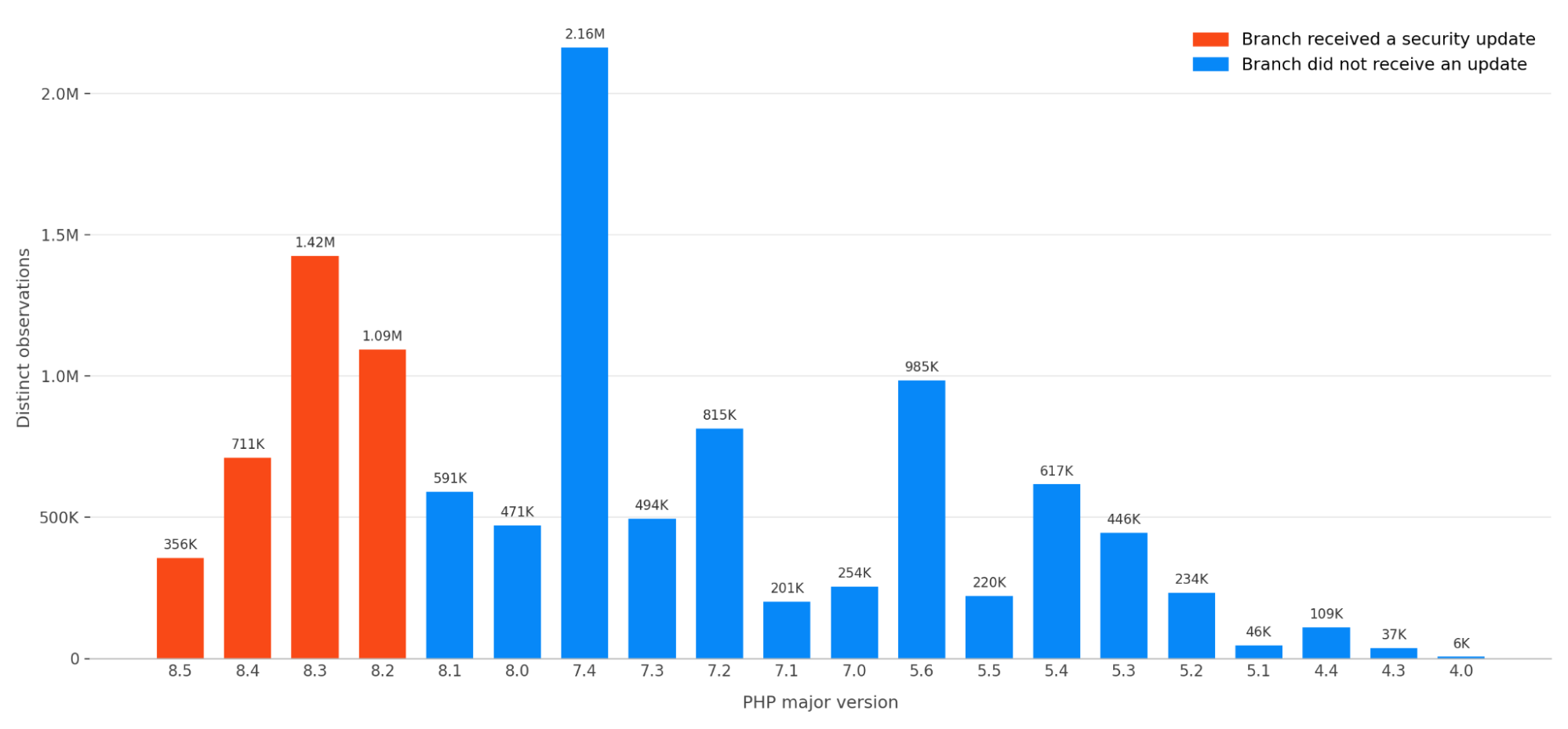
According to Bitsight Threat Intelligence
Bitsight Threat Intelligence assigns CVE-2026-109618 a Dynamic Vulnerability Exploit (DVE) score of 9.91 out of 10, and CVE-2026-109619 a score of 9.84, driven by significant discussion of these vulnerabilities across open and dark web sources, with one dark web exploit forum user noting: “[the] Internet will be on fire.” DVE estimates how likely a vulnerability is to be exploited over the following 90 days.

CVE-2026-109618 and CVE-2026-109619 technical overview
Attribute | Details |
| Vulnerabilities | CVE-2026-109618, CVE-2026-109619 |
| Incident type | Critical remote code execution in PHP core, with exploit details leaked before a fix existed. |
| Affected products | The PHP team has indicated that all PHP installations serving web requests, including PHP-FPM, Apache with mod_php, php-cgi, FrankenPHP and LiteSpeed are impacted. |
| CVSS v4.0 score | 9.2 (Critical) for each, according to the security advisories. |
| Potential impact | Arbitrary command execution as the PHP process user, which could allow takeover of the hosted application and server. |
| Fixed releases | PHP 8.5.12, 8.4.27, 8.3.36 and 8.2.35 fix the vulnerabilities. PHP 8.1 and older are no longer supported; however, the PHP team released minimal source-backports for PHP 7.4, PHP 8.0, and PHP 8.1. |
| Workaround | The security advisories indicate that there is no generic configuration mitigation for either vulnerability and that applying updates is the only complete mitigation. |
| Exploitation status | Early evidence of exploitation has been reported by security vendors. |
Why this matters
PHP runs a very large portion of the web, from content management systems and online shops to bespoke internal tools. A flaw in the runtime can’t be repaired by changing application code, and a web application firewall or plugin update won’t remove it. Only updating PHP on the host itself closes the gap.
Attackers are likely to move the moment the fix is public. By comparing the patched PHP source against the previous release, and using AI tooling to speed up the analysis, they can locate the flaw and produce a working exploit in a fraction of the time this once took. Organizations should therefore plan for a likely incident, not a routine patching cycle.