Introduction
In order to collect various security-related metrics, Bitsight scans the entire internet, collecting a unique set of data that enables us to carry out a variety of studies that would be extremely difficult for any other company to conduct.
One of the metrics that we collect is related to the presence of certain vulnerabilities. For this, we need to take into consideration all possible mitigation strategies that are available and that allow us to reduce the risk.
When a vulnerability is disclosed, besides patching, the vendor can sometimes suggest a workaround that will also mitigate the risk. In these cases, a simple version comparison isn't enough, we need to interact with those systems in a specific way that would allow us to safely detect any mitigation that has been applied and determine their vulnerability status. This also allows us to determine which type of mitigation was applied, whether patching or a workaround, which gives us insight into what mitigation strategies companies are using for different CVEs, on different products, across different sectors.
At the end of 2024, Bitsight TRACE started analyzing all the vulnerability data collected throughout the last 18 months for a set of selected vulnerabilities to determine the “Patch vs. Workaround” trend.
This blog post focuses on the analysis of CVEs and the industry's approach to fixing security issues, whether through patching, implementing a workaround, or both.
Understanding modern vulnerability management: A deep dive into critical CVEs
In this blog post, we will perform an in-depth analysis of six Common Vulnerabilities and Exposures (CVEs) to understand how companies are defending against these vulnerabilities. Specifically, we will compare two primary mitigation strategies: updating to a recent version of the software (patching) versus applying a modification to the existing vulnerable version (workaround).
To conduct this analysis, we selected several vulnerability detection methods that rely on actively probing for a specific CVE instead of using those that are based on version checks. These probes interact with the target systems, triggering specific responses and/or behaviors that allow us to determine whether they are vulnerable, have been patched, or if a workaround has been applied. By doing so, we can accurately assess the mitigation strategies employed by different organizations.
We have categorized the CVEs into two groups: recent vulnerabilities and older vulnerabilities. This categorization allows us to observe any differences in mitigation strategies over time.
The CVEs we will be analyzing are as follows:
| Product | CVEs |
|---|---|
| ConnectWise ScreenConnect | |
| Microsoft Exchange Server | |
| JetBrains TeamCity | |
| Juniper JunOS |
By covering multiple products and analyzing these CVEs, we aim to provide valuable insights and statistics on how companies defend against vulnerabilities. This analysis will help us understand the effectiveness of different mitigation strategies and identify any trends in vulnerability management.
Dissecting CVE-2022-41040: Insights into the Microsoft Exchange Server exploit
CVE-2022-41040 is a Server-Side Request Forgery (SSRF) vulnerability. This flaw allows an authenticated attacker to remotely trigger another vulnerability, CVE-2022-41082, which permits remote code execution when PowerShell is accessible. These vulnerabilities are known as ProxyNotShell, which enables attackers to execute arbitrary commands on the affected Exchange Server, potentially leading to complete system compromise.
To understand how CVE-2022-41040 remediation was addressed, we examined data from Internet-wide scans conducted from July 2023 to December 2024. These scans evaluated whether hosts remediated the vulnerability through patching or workaround. In total, we detected 44,180 vulnerable systems. Of these, 11,141 systems were remediated at some point.
The time to remediation distribution highlights important patterns in how the vulnerability was addressed across different timeframes:
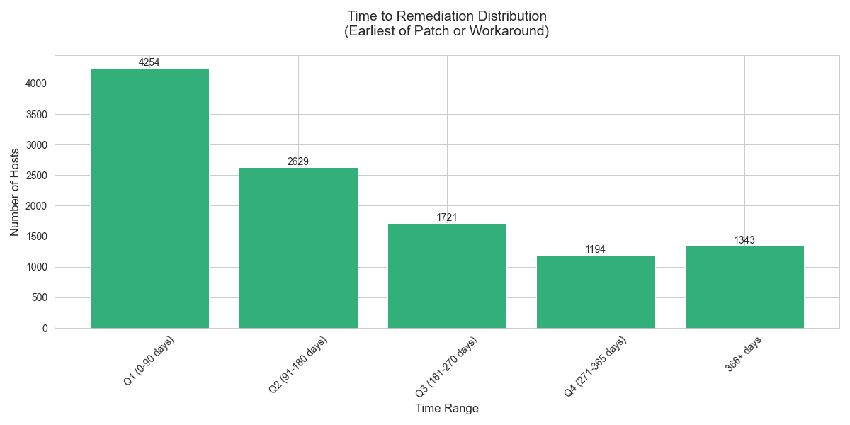
In the first 90 days, we saw the highest remediation activity, with 4,254 hosts addressed, showing a strong initial response following the vulnerability disclosure. However, the significant drop to 2,629 hosts in the next quarter (91-180 days) suggests that after the initial surge, fixing the remaining systems becomes much more challenging.
What's especially noteworthy is that 1,343 hosts, about 12% of all remediated systems, took over a year to implement fixes. One of the many reasons for this may be the fact that, given its nature and importance for the business, companies are likely to consider Exchange Servers as part of their critical infrastructure, and the patch management process in place for these is much stricter, requiring several tests and not allowing it to be done all at once. Also, considering how widespread Exchange Servers are, some versions are too old to be updated, so patching may not even be an option. This pattern demonstrates that while security maturity varies widely, the biggest challenge lies not in identifying vulnerabilities but in the organizational capability to respond effectively.
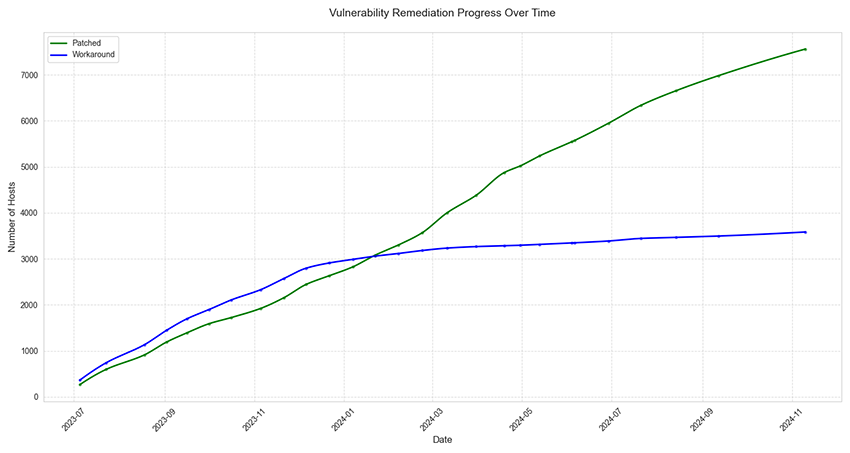
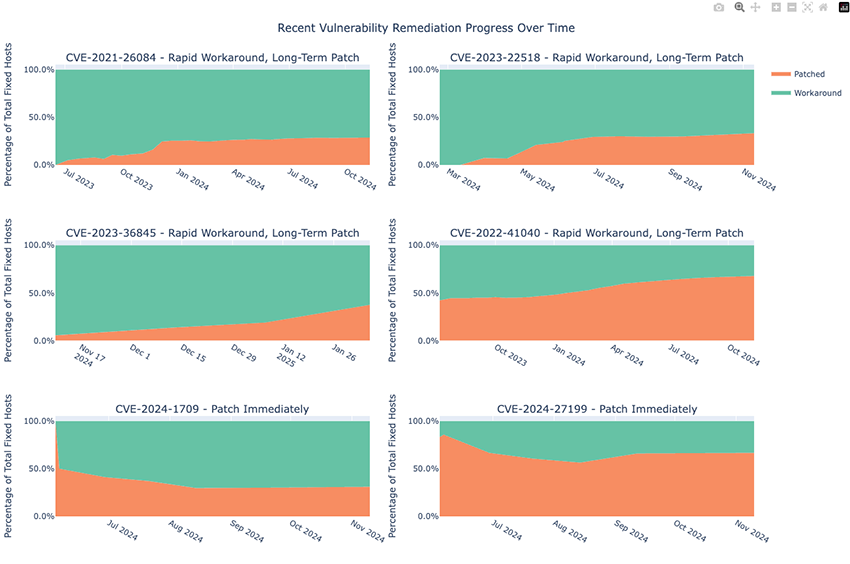
From the timeline of accumulated remediation detections, we can observe that initial remediation efforts began slowly in July 2023 but gained momentum by late 2023. A notable divergence between patching and workaround approaches emerged around January 2024, with organizations increasingly favoring complete patches over temporary workarounds. By the end of the observation period, approximately 7,500 hosts had been patched, while roughly 3,500 had implemented workarounds.
Many organizations initially implemented temporary workarounds but later transitioned to full patching. This shift aligns with best practices for long-term vulnerability management. This approach reflects a commitment to not just quick fixes but also to sustainable and comprehensive security measures.
Examination by industry sector
Since Exchange was such a popular product, we had the opportunity to analyze how different industry sectors compared in remediating the same vulnerability. Pulling from our proprietary firmographic data, we were able to categorize 6,237 remediated instances out of 44,180 total instances into 23 defined sectors of various sizes. There were 4,904 instances which did not pertain to a known organizational entity. Sectors ranged in size from 3,278 remediated hosts within Service Providers to 5 remediated hosts for Credit Union.
We have provided an interactive plot allowing you to zoom in to dissect the various sectors.