What is DORA?
The Digital Operational Resilience Act (DORA) is a pivotal regulation aimed at enhancing the operational resilience of financial entities within the European Union. By establishing comprehensive requirements for managing information and communication technology (ICT) risks, DORA ensures that financial institutions can withstand, respond to, and recover from all types of ICT-related disruptions and threats.
The 5 DORA Requirements
Cyber risk management strategies and third-party risk management programs in particular need to evolve to address DORA requirements across five key pillars:
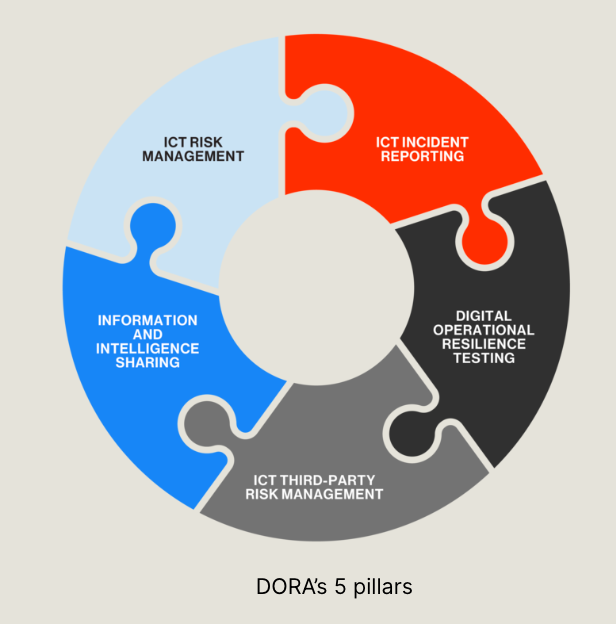
1. ICT Risk Management
Financial entities are required to implement robust Information and Communication Technology (ICT) risk management frameworks. These should be integrated into their overall risk management strategy and encompass identification, protection, detection, response, and recovery measures. The frameworks should also address internal and external risks, including those posed by third-party providers, and ensure governance oversight with clear accountability at the senior management level. Regular assessments and updates are critical to adapt to evolving cyber threats and vulnerabilities.
Scope of Application:
- Governance (accountable management body)
- Risk management framework and associated activities (identification, protection and prevention, detection, response and recovery, learning and evolving, crisis communication)
2. ICT Incident Reporting
DORA mandates a structured process for reporting significant ICT-related incidents, including classifying incidents based on severity and providing details such as impact and response actions. Entities must notify competent authorities without undue delay, ensuring timely responses and facilitating coordinated efforts to mitigate broader impacts across the financial sector.
Scope of Application:
- Standardised incident classification
- Compulsory and standardised reporting of major incidents Anonymized EU-wide reports
3. Digital Operational Resilience Testing
Regular testing of digital operational resilience is a core requirement under DORA. Entities must conduct vulnerability assessments, penetration tests, and scenario-based testing that simulate real-world cyber threats. Critical entities may also be required to conduct Advanced Threat-Led Penetration Testing (TLPT). Insights gained from these tests should inform continuous improvements to resilience strategies and cybersecurity frameworks.
Scope of Application:
- Comprehensive testing program, with a focus on technical testing
- Large-scale, threat-led live tests performed by independent testers every three years
4. Information and Intelligence Sharing
DORA encourages the sharing of cyber threat information among financial entities, fostering collaboration to strengthen the sector’s overall defense mechanisms. Information-sharing arrangements, including participation in industry-wide platforms, enhance collective awareness of emerging threats and promote best practices. Regulatory cooperation is also emphasized to support coordinated responses to systemic risks.
Scope of Application:
- Guidelines on information sharing arrangements for cyber threats and vulnerabilities
5. ICT Third-Party Risk Management
Entities must assess and continuously monitor risks associated with third-party ICT service providers, ensuring that contractual agreements include provisions for security, incident reporting, and operational resilience. Regular vendor risk assessments and continuous monitoring are key to achieve this. Critical ICT third-party providers may be subject to additional oversight to safeguard the financial ecosystem.
Scope of Application:
- Strategy, policy, and standardised register of information
- Guidelines for pre-contract assessment, contract contents, termination, and stressed exit
- Create oversight framework for critical providers across the EU with clear requirements and penalties