Drowning in data
Consider this scenario: a critical zero-day vulnerability is announced for a popular enterprise software and you, as a threat analyst, are tasked with briefing leadership on which threat actors are exploiting it and how. You start to research and are immediately overwhelmed. One news site reports on a Chinese APT using the exploit, another blog details an Iranian group, and a third report lists CVEs without context. You have a dozen articles open and are trying to build a master timeline in a spreadsheet, but the data is conflicting and messy. You spend hours just trying to figure out which malware belongs to which campaign, thinking, "I wish someone could make sense of all of this. I need the full picture to know how to prepare for what comes next."
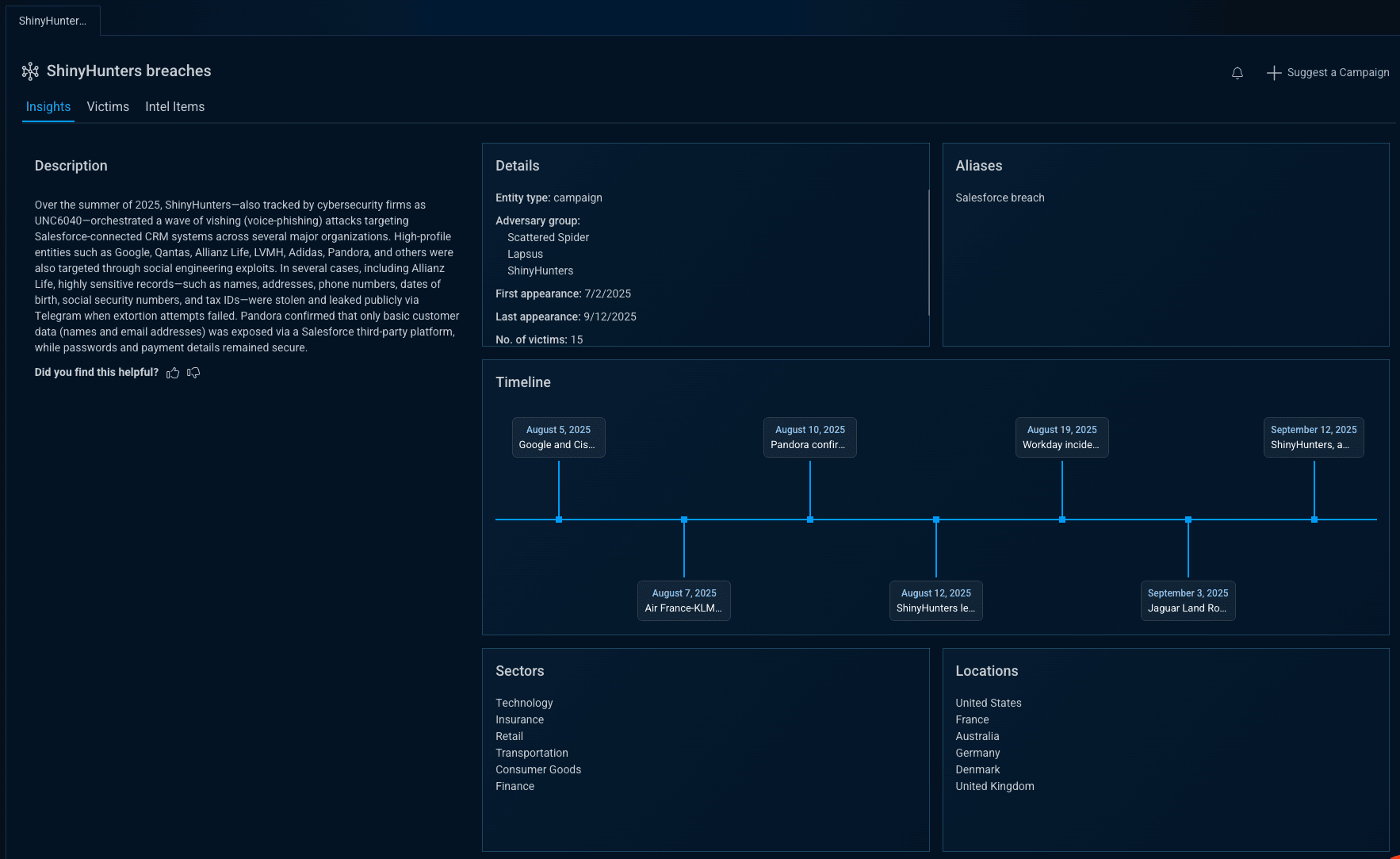
Cyber attacks happen all the time. But are they coordinated without rhyme or reason? Or are they connected to each other, potentially part of a larger campaign? And, more significantly, is your organization the next target?
Connect the dots to see the bigger picture
Cyber threat analysts struggle to manually stitch together a narrative. And frankly, the struggle is real. Currently, security teams rely on fragmented, tactical approaches to threat data. This includes:
- Siloed alerts: They investigate incidents one by one (phishing emails, malware detections, CVE exploits) without visibility into how they might connect.
- Generic CTI feeds: They subscribe to broad, undifferentiated threat intelligence that lacks context or correlation, forcing analysts to manually stitch together meaning.
- Manual correlation: Analysts attempt to link related activity across log sources, threat feeds, and incident data with spreadsheets or ad hoc investigations.
- Reactive response: Without understanding the bigger picture, teams often respond late or miss the strategic objective behind repeated or coordinated activity.
Practically speaking, analysts must detail the painful, manual process of sifting through this unstructured data. An analyst must open 20+ tabs, read through paragraphs of text, and manually copy-paste actor names, victim details, and CVEs into a spreadsheet or wiki. This process is slow, error-prone, and leads to an incomplete picture.