How Bitsight Builds a Trusted, Accurate Security Rating
The accuracy and trustworthiness of a security rating depends entirely on the quality of its underlying data and the rigor of its methodology. Bitsight has invested more than a decade in building both. The result is a ratings engine that ingests over 400 billion events every day from more than 100 data sources — many of them exclusive — and processes that data through a sophisticated pipeline to produce ratings that are demonstrably correlated with real-world security outcomes.
The Data Foundation: What Bitsight Observes and How
Bitsight collects data entirely from external sources, meaning all observations are made from the perspective of the open internet rather than from inside an organization's network. This approach enables Bitsight to rate hundreds of thousands of organizations worldwide without requiring any cooperation, installation, or access from the rated entity. It also ensures that the rating remains independent and objective regardless of whether an organization is a Bitsight customer.
Data collection operates through two complementary methods. The first is passive listening: Bitsight maintains an extensive network of sensors deployed at key locations across the internet that capture DNS queries and responses, malicious traffic patterns including DDoS activity, brute force attack signatures, file sharing behavior, endpoint device identifiers, IoT device traffic, and BGP announcements. The second is active probing: Bitsight uses non-intrusive techniques to observe open ports, server software versions and configurations, known CVEs, DNS records including SPF and DKIM, and web application characteristics. Bitsight does not conduct penetration testing or any other intrusive activity.
The quality control layer is equally important. Real-world internet-scale data is inherently noisy. Bitsight applies a combination of human expertise and machine intelligence, including a sophisticated rules engine, to separate meaningful signals from noise and eliminate false positives. The company has collected petabytes of security-relevant data since its founding, and the corpus of historical data has enabled continuous refinement of these quality processes.
Network Mapping: Attributing Observations to the Right Organization
Before any observation can contribute to a rating, it must be accurately attributed to the correct organization. Bitsight accomplishes this through its network mapping capability, which builds and continuously maintains a map of the IP addresses — both IPv4 and IPv6 — and domain names that each organization owns exclusively.
Network maps are constructed using both public data sources, such as Regional Internet Registry records and DNS entries, and proprietary techniques that Bitsight has developed internally. Because network maps change constantly as organizations acquire, divest, or migrate assets — especially in cloud-heavy environments — Bitsight's mapping processes run continuously to keep attributions current. Each day's new observations are matched to the relevant organization based on the IP address or hostname where the observation occurred.
The 25 Risk Vectors That Drive a Bitsight Security Rating
Once observations are attributed to an organization, they are mapped onto a structured set of risk vectors. Each risk vector measures a specific area of security performance. Bitsight currently uses 25 risk vectors, grouped into four categories: Compromised Systems, User Behavior, Diligence, and Public Disclosures. Each category carries a different weight in the overall rating, reflecting the relative predictive importance of each type of signal.
Must-Have Coverage Areas for a Complete Security Rating
Compromised Systems (27% weight): This is the highest-weighted category in the rating because the presence of compromised systems is among the strongest indicators of security control failure. It includes botnet infections detected through sinkholing and other techniques, potentially exploited systems running greyware or adware, unsolicited communications from systems scanning for new hosts to infect, spam propagation from compromised machines, and malware servers hosting malicious software.
User Behavior (2.5% weight): This category captures observable risky behaviors by employees, most notably file sharing over peer-to-peer networks such as BitTorrent. Files from these sources carry significant malware risk and reflect gaps in endpoint control and acceptable use policy enforcement.
Diligence (70.5% weight): This is the most heavily weighted category and encompasses a broad range of observable security hygiene practices. It is broken into five subcategories:
- Network Services: Covers TLS/SSL certificate validity and algorithm strength, TLS/SSL configuration quality and encryption standards, open ports exposed to the internet, and DNSSEC implementation.
- Software Assets: Covers server software versions and patching status, desktop software currency across browsers and operating systems, mobile software updates, patching cadence for critical vulnerabilities, and insecure systems making unexpected external connections.
- Application Security: Covers mobile application security for apps published on the Apple App Store or Google Play, and web application security including authentication controls, access management, sensitive data exposure, cross-site scripting prevention, and security misconfigurations.
- Email Security: Covers SPF records to prevent email spoofing from unauthorized senders, DKIM records to protect domain-based email authenticity, and DMARC policy verification as a non-rating-impacting informational signal.
Public Disclosures: Covers security incidents and breaches drawn from verifiable external sources including regulatory filings and reputable news organizations. Sufficiently severe incidents are incorporated into the overall rating calculation with a time-decaying impact.
Each finding within a risk vector is evaluated against empirical research on breach correlation, recommendations from standards bodies like NIST, the National Vulnerability Database, and established security practitioner guidance. Bitsight uses this multi-source evaluation approach to ensure that the weight assigned to any given finding reflects its actual predictive value.
How the Rating Is Calculated: Scoring, Normalization, and Time Decay
Translating raw observations into a final numerical rating requires several layers of statistical processing. Understanding this pipeline helps security and risk teams interpret rating changes accurately and use the metric with appropriate precision.
Step-by-Step: From Raw Data to a Published Security Rating
Step 1 — Compute raw scores for each risk vector: For each risk vector, Bitsight computes a raw score based on a weighted count of findings, adjusted for time decay where applicable. Findings related to compromised systems and security incidents carry the greatest impact on the date they occur, with that impact gradually declining as the event ages. This mirrors the logic used in consumer credit ratings, where recent negative events are more predictive than older ones. Diligence findings, which reflect the current state of observable configurations, are updated as soon as a change can be reliably confirmed, or continue to affect the rating for a 60-day window if no update is detected.
Step 2 — Apply size adjustment: Larger organizations have more assets and therefore more opportunities for adverse findings to occur. Without size adjustment, a large enterprise with two botnet infections would receive a worse rating than a two-person company with the same number of infections, despite likely having superior security controls. Bitsight corrects for this by analyzing the distribution of event frequency across organizations of different sizes, ensuring that ratings are comparable across the full population regardless of organizational scale.
Step 3 — Convert to percentiles: After size adjustment, each risk vector score is converted to a percentile by ranking the organization against the full population of rated entities across all industries and geographies. Percentile ranking serves two purposes: it provides a stable, interpretable basis for comparison, and it insulates ratings from fluctuations caused by external events, such as a new malware family causing a spike in infections across many organizations simultaneously. In such cases, percentile-based scoring preserves the relative meaning of each rating even as raw counts shift.
Step 4 — Assign letter grades: Each risk vector receives a letter grade from A through F based on the organization's percentile. An organization in the top 10% of performers on a given vector receives an A. These grades are then multiplied by their respective risk vector weights and summed to produce a raw overall rating.
Step 5 — Normalize to the 250-900 scale: The raw overall rating is normalized to produce the final Bitsight Security Rating on the 250-900 scale. This normalization is updated daily to reflect shifts in the underlying distribution of all rated organizations. To avoid conveying false precision, ratings are rounded down to the nearest ten-point boundary. The distribution is calibrated so that most organizations receive ratings toward the higher end of the scale, reflecting the empirical reality that data breaches, while impactful, remain relatively uncommon across the broader population.
Step 6 — Apply security incident adjustment: If an organization has experienced a qualifying security incident such as a confirmed data breach, the overall rating is adjusted downward by an amount that reflects the severity of the incident and the size of the organization. This adjustment decays over time, consistent with the empirical evidence that past incidents are predictive of future risk but with diminishing relevance as time passes.
Step 7 — Reflect remediation rapidly through Dynamic Remediation: Organizations that use Bitsight Groma's continuous scanning can trigger instant rescans after remediating a finding. Confirmed remediations automatically stop impacting the rating, and improvements are reflected in the next daily update. This closes the feedback loop between remediation activity and measurable rating impact.
Best Practices for Using Bitsight Security Ratings Over Time
A security rating is only as valuable as the program built around it. Bitsight works with thousands of organizations across industries and has identified the operational disciplines that separate teams who derive sustained value from ratings from those who treat them as a single data point. The following practices represent the standard for effective, long-term use of the platform.
Treat the rating as a continuous KPI, not a periodic checkpoint: The value of a daily-refreshed rating comes from monitoring it continuously, not reviewing it quarterly. Configure alerts for significant changes in your own rating and in the ratings of your critical third parties so that your team can investigate promptly rather than discovering issues during a scheduled review.
Use risk vector grades to prioritize remediation work: The overall rating tells you where you stand. The individual risk vector grades tell you what to fix. Teams that drill into vector-level performance can identify the specific control gaps — outdated TLS configurations, slow patching cadence, open ports — that are driving their score down and can sequence remediation work based on the weight each vector carries in the overall calculation.
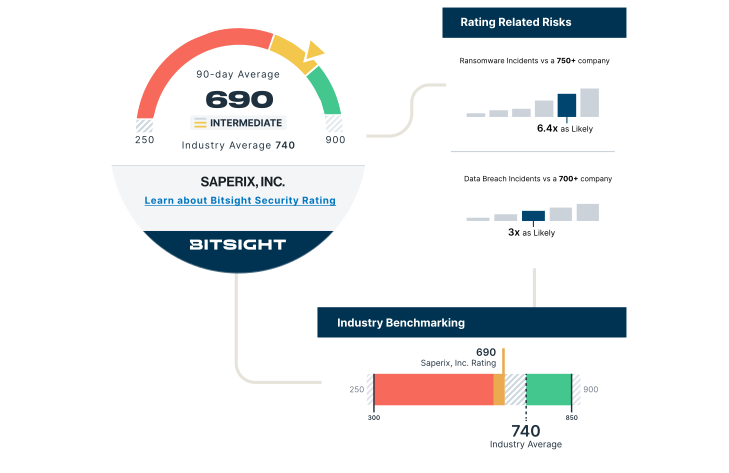
Benchmark against industry peers to contextualize performance: A rating of 700 means something different in the financial services sector than it does in manufacturing. Bitsight provides the population data necessary to benchmark your rating against organizations in your specific industry and geography. Use this context when reporting to executives and boards, as peer comparison provides the business context that a raw number alone cannot convey.
Incorporate ratings into third-party risk workflows: The most common use case for Bitsight Security Ratings is vendor risk management. Best-practice programs use ratings to tier vendors by risk, set minimum acceptable score thresholds for onboarding, trigger enhanced due diligence when a vendor's rating drops below a defined level, and monitor the vendor portfolio continuously rather than relying on annual questionnaires.
Use the rating as a communication tool with non-technical stakeholders: The numerical format of a security rating is intentionally accessible. Security leaders should use it to communicate risk to board members, audit committees, and executive sponsors who may lack the background to interpret technical findings. Bitsight's reporting capabilities make it straightforward to present rating trends, peer benchmarks, and remediation progress in terms that resonate with business-oriented audiences.
Leverage the dispute process to ensure accuracy: Bitsight's Policy Review Board governs a formal dispute resolution process that is open to all rated organizations, not just customers. If your organization believes a finding is attributable to an asset you do not own, or that a data point has been misinterpreted, the dispute process provides a structured path to challenge and correct the record. This process is a feature, not a burden — use it to ensure your rating is as accurate as possible.
Monitor rating changes following M&A activity: When an organization acquires another company, the network map of the acquired entity is eventually attributed to the acquirer, bringing all associated findings with it. Teams involved in M&A transactions should use Bitsight to assess the security posture of acquisition targets before closing, and to monitor post-close rating changes as the combined organization's asset footprint consolidates.
How Bitsight Simplifies and Scales Security Ratings Across the Enterprise
Bitsight is the company that invented the cybersecurity ratings category, and it has spent more than a decade building the data infrastructure, analytical capabilities, and governance processes that make enterprise-scale use of security ratings practical. Several specific capabilities distinguish the Bitsight platform from other approaches to external risk measurement.
Bitsight Groma, the company's next-generation internet scanning technology, continuously monitors the global attack surface to identify vulnerabilities, misconfigurations, and asset changes. Because Groma operates continuously rather than on a fixed scanning schedule, it powers Dynamic Remediation — the capability that ensures a confirmed fix is reflected in an organization's rating as quickly as the next daily update. This closes a critical gap that has long frustrated security teams: the lag between doing the work of remediation and seeing that work acknowledged in a measurable metric.
The ratings are built on the industry's most extensive external cybersecurity dataset, ingesting over 400 billion events daily from more than 100 sources. This breadth of data, combined with Bitsight's proprietary attribution and quality control processes, produces ratings that are independently verified to correlate with real-world security outcomes. Organizations with low Bitsight Security Ratings are more than five times as likely to experience a data breach as those with high ratings, according to a database of more than 16,000 documented security incidents analyzed against historical ratings data from 2015 onward. These correlations have been verified by independent third parties including the Marsh McLennan Cyber Risk Analytics Center, AIR Worldwide, and IHS Markit.
Bitsight's AI capabilities are embedded across the platform, enhancing every layer from data collection and attribution to insight generation and decision support. With more than 10 years of historical ratings data, Bitsight's models carry a depth of longitudinal signal that newer entrants to the ratings space cannot replicate. This history supports trend analysis, predictive risk modeling, and the kind of stable, comparable ratings that long-term programs require.
The platform serves use cases across the full enterprise risk stack: security performance management for internal teams, third-party risk management for vendor portfolios, cyber insurance underwriting and procurement, M&A due diligence, and regulatory compliance reporting. Bitsight's commitment to the US Chamber of Commerce Principles for Fair and Accurate Security Ratings — which Bitsight helped develop — ensures that every rating is produced according to documented, transparent, independently governed standards.
Key Takeaways and How to Get Started with Bitsight Security Ratings
Bitsight Security Ratings provide the cybersecurity industry's most trusted, continuously refreshed, and independently verified measure of organizational security performance. They are built on over 400 billion daily events, governed by a transparent methodology, and validated against a database of more than 16,000 real-world security incidents. The rating covers 24 risk vectors across four categories, is normalized for organization size and population distribution, and is updated daily with Dynamic Remediation capabilities that ensure your score reflects your current state — not a weeks-old snapshot.
For security and risk teams, the practical starting point is to claim your organization's rating, review your risk vector grades to identify the highest-impact remediation opportunities, and establish continuous monitoring for yourself and your critical third parties. For executives and board members, the rating provides a defensible, comparable benchmark for communicating cyber risk in business terms. For insurers, investors, and regulators, it offers the independent, verifiable signal needed to make risk-informed decisions at scale.
To see your organization's Bitsight Security Rating and benchmark your performance against your industry peers, contact the Bitsight team to request a free rating report or schedule a platform demonstration.