Cyber resilience for the modern enterprise

Today’s enterprises cannot prevent every cyber event. What they can do is become more resilient—by continuously identifying exposure, understanding which threats matter most, and aligning security and risk teams around the same intelligence. Bitsight helps CISOs bring the SOC and GRC together in one cyber risk intelligence platform for exposure management, third-party risk management, and threat intelligence.

What is cyber resilience?

Cyber resilience is an organization’s ability to anticipate, withstand, recover from, and adapt to cyber events without losing control of critical business operations.

For CISOs, cyber resilience has become more than a security objective. It is now a business requirement. As digital ecosystems expand across cloud environments, vendors, contractors, subsidiaries, and software supply chains, resilience depends on more than internal controls alone. It depends on visibility across your extended attack surface and the ability to act on real-world cyber risk.

A resilient cybersecurity program does not assume perfect prevention. It assumes continuous change, evolving adversaries, and third-party dependencies—and it equips teams to reduce impact when incidents occur.

Why cyber resilience matters now

Security leaders are being asked to protect business growth in an environment defined by constant disruption. Modern enterprises face:

  • Expanding attack surfaces across cloud, SaaS, subsidiaries, and shadow IT
  • Rising dependence on third parties and fourth parties
  • Faster-moving threats, including ransomware, credential exposure, and exploit activity
  • More regulatory and board-level pressure to demonstrate control and operational readiness
  • Growing demand to connect technical findings to business risk and resilience outcomes

This is why cyber resilience is gaining momentum. The conversation is shifting from “How do we stop everything?” to “How do we continuously reduce exposure, prioritize what matters, and stay operational when disruption happens?”

How cybersecurity leaders are redefining resilience

Gartner’s recent cybersecurity research points to a clear change in how leaders are approaching resilience. The emphasis is moving toward business continuity, collaborative risk management, and resilience-oriented approaches to third-party cyber risk. That shift matters because most enterprises do not struggle from a lack of alerts. They struggle from fragmented context.

The SOC may see external threats, exploited vulnerabilities, and attack surface issues. GRC and TPRM teams may see assessments, controls, and vendor workflows. But when these teams operate in separate systems, the organization lacks a shared understanding of true cyber risk.

Cyber resilience improves when teams can work from a common picture of exposure, threat activity, and third-party dependencies.

Why traditional cyber resilience programs fall short

Many cyber resilience initiatives are still built on disconnected tools and point-in-time processes.

Common gaps include:

  • Periodic vendor reviews that miss fast-changing third-party risk
  • Exposure management programs that do not incorporate threat intelligence
  • Threat intelligence tools that are disconnected from business context and vendor relationships
  • GRC workflows that cannot easily incorporate real-time external evidence
  • Executive reporting that tracks activity, but not meaningful risk reduction

This fragmentation creates friction between the SOC and GRC. Security operations teams are measured on detection and response. Risk and compliance teams are measured on governance, assessments, and policy alignment. CISOs are left trying to connect both worlds manually.

Cyber resilience requires a shared intelligence layer across exposure, threats, and third-party risk

Bitsight’s view is simple: cyber resilience becomes measurable and operational when organizations unify three things:

  • Exposure intelligence to understand where the organization and its vendors are vulnerable
  • Threat intelligence to understand what adversaries are doing and which risks are becoming active
  • Third-party risk intelligence to understand which vendors, partners, and relationships could amplify business impact

That is where Bitsight is uniquely differentiated.

Bitsight brings together real-time exposure data, deep and dark web threat intelligence, and vendor intelligence in a single cyber risk intelligence platform. This gives CISOs a more complete view of risk across the enterprise and digital supply chain—and gives SOC and GRC teams a common operating picture.

Why enterprises choose Bitsight for cyber resilience

  • One platform for the SOC and GRC
    Bitsight helps connect technical risk signals to governance and decision-making. Security teams can monitor threats, vulnerabilities, and external exposure in real time, while GRC and TPRM teams can use that same intelligence to prioritize vendor oversight, assessments, and remediation.
  • True threat intelligence built into cyber risk workflows
    Many platforms treat threat intelligence as a separate function. Bitsight brings it directly into exposure and third-party risk workflows, helping teams prioritize based on actual adversary activity, compromised credentials, ransomware signals, exploit relevance, and underground chatter.
  • Visibility across your extended attack surface
    Bitsight helps organizations understand risk across internal assets, subsidiaries, cloud environments, third-party vendors, and fourth-party relationships. This broader visibility is essential for resilience because disruption often starts outside traditional security boundaries.
  • Continuous monitoring instead of static snapshots
    Cyber resilience is not a once-a-year assessment. Bitsight continuously monitors external exposure and vendor risk so teams can identify meaningful changes earlier and respond faster.
  • Business context for better prioritization
    Bitsight enriches raw cyber data with business context so teams can focus on the threats, exposures, and third parties that matter most to operations, resilience, and executive risk priorities.

How Bitsight helps operationalize cyber resilience

Exposure Management

Discover internet-facing assets, identify vulnerabilities and misconfigurations, map shadow IT, and prioritize remediation across your attack surface.

Cyber Threat Intelligence

Track emerging threats, TTPs, IOCs, ransomware activity, compromised credentials, and underground signals that help teams understand which risks are becoming active.

Third-Party Risk Management

Move beyond static questionnaires with continuous monitoring, real-time vendor intelligence, and workflows that help teams assess, prioritize, and manage third-party cyber risk more efficiently.

Governance and reporting

Translate cyber exposure into business-relevant reporting that helps CISOs communicate posture, trends, and resilience priorities to executives and the board.

What cyber resilience looks like across the organization

Cyber resilience for CISOs

  • Build a resilience strategy grounded in real-world cyber risk
  • Create shared visibility across the SOC, GRC, and TPRM functions
  • Communicate priorities to executive stakeholders with more confidence

Cyber resilience for SOC leaders

  • Prioritize issues using threat context, not just technical severity
  • See how external exposure and underground activity affect enterprise and vendor risk
  • Focus response efforts on the risks most likely to impact the business

Cyber resilience for GRC and TPRM leaders

  • Strengthen third-party risk decisions with objective external evidence
  • Continuously monitor vendor posture instead of relying only on point-in-time reviews
  • Align governance actions to live risk signals and resilience objectives
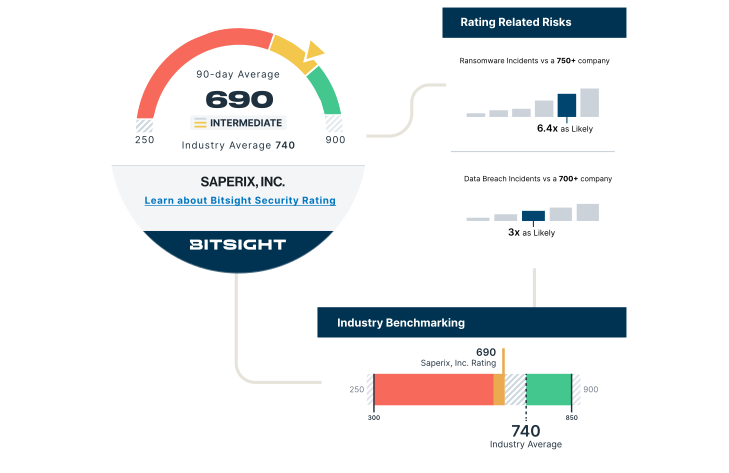
Security Ratings example: rating score and benchmarking

Free cyber risk report

Get a report built on your actual external infrastructure—domains, IPs, certificates, cloud assets—and benchmarked against real-world breach data.