When people discuss DragonForce, two distinct names usually come up: DragonForce Ransomware and DragonForce Malaysia. To set the record straight, the ransomware operation isn't necessarily the same entity as DragonForce Malaysia. DragonForce Malaysia operates as a politically driven hacktivist collective known for pro-Palestinian campaigns, defacing websites, launching DDoS attacks, and leaking data.
The ransomware group we're diving into here, on the other hand, is purely financially motivated. While security reports sometimes link the two, that connection hasn't been confirmed. The ransomware group gained notoriety during a wave of UK retail attacks in April 2025. Cybersecurity analysts linked affiliates of Scattered Spider (a group based in the United States and United Kingdom) to this activity. It began as a standard social engineering tactic and quickly snowballed into major operational disruptions.
Who is DragonForce ransomware group?
Data from Bitsight Threat Intelligence shows that DragonForce's attacks mostly focus on the US and the UK, though their reach also extends to organizations in Australia, Canada, Italy, and beyond. Rather than zeroing in on a single industry, they tend to be pragmatic opportunists. A broad mix of sectors including professional services, manufacturing, real estate, logistics, retail, healthcare, and technology have surfaced in public intelligence reports or on the group's dedicated leak site (DLS).
DragonForce first popped up on the ransomware scene back in August 2023. In the beginning, their early iterations relied on leaked code from LockBit 3.0. Later on, security researchers spotted a different build built on Conti v3 source code, packed with upgraded capabilities like adjustable encryption settings, scheduled runs, embedded drivers, and features designed to neutralize security tools.
By June 2024, the group started heavily pitching an affiliate program. They enticed partners with an 80% cut of ransom payouts alongside a full-featured management panel for generating payloads, tracking victims, setting team permissions, running negotiations, timing data leaks, and issuing decryption keys. Fast forward to March 2025, and DragonForce began branding their service as a “cartel.” In practice, this shift introduced a white-label arrangement that gave affiliates the freedom to leverage DragonForce tools and infrastructure while running operations under their own brand names.
DragonForce hasn't shied away from fighting for market share in the ransomware space, either. Industry reporting tied them to defacement attacks against the BlackLock and Mamona leak sites, as well as a heated rivalry with RansomHub. Then, in 2025, DragonForce, LockBit, and Qilin went public with a strategic alliance. That partnership signaled a clear push to pool resources and expand their collective reach across the affiliate market.
How does DragonForce’s model work?
At its core, DragonForce supplies the backend infrastructure for ransomware operations. Across their promo materials, they've highlighted capabilities such as:
DragonForce’s affiliate tools and services
- Ransomware builders and customized victim payloads
- Windows and VMware ESXi encryption capabilities
- Claimed NAS support in affiliate advertisements
- Leak-site hosting and distributed file storage
- Victim, team, and access management panels
- Negotiation, call, and decryption services
- Publication scheduling and hidden victim pages
- Options intended to disable or bypass endpoint security tools
- Data analysis intended to strengthen extortion and negotiation pressure
A newer focus on recruitment and data analysis
On September 22, 2026, Bitsight Threat Intelligence flagged a new post on DragonForce's leak site. The group was actively recruiting developers skilled in C/C++, Rust, and Go, alongside reverse engineers and researchers holding zero-day exploits, offering a revenue-sharing partnership model. In the post-frontier AI world, this highlights just how eager threat actors remain to acquire zero-days for initial compromise.

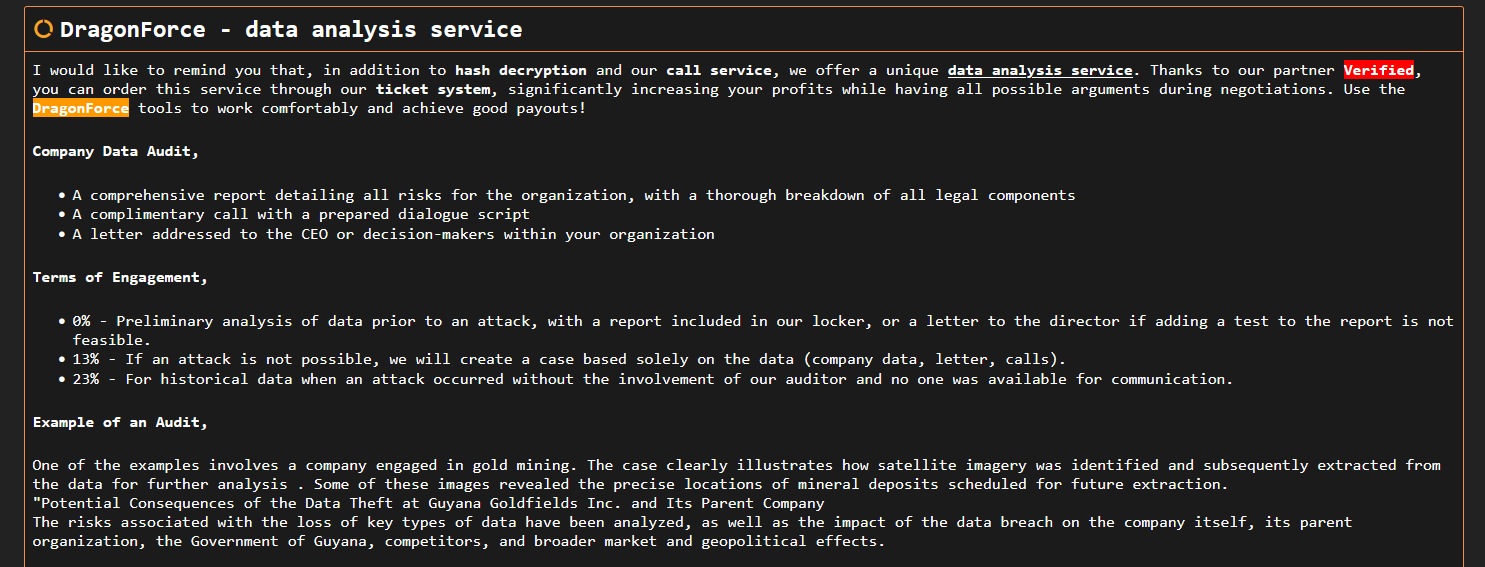
In a separate leak site post, the group rolled out a tailored “data analysis service.” DragonForce claimed it could go through exfiltrated corporate files, map out key legal and operational vulnerabilities, put together an analysis report, write up call scripts, and draft extortion letters aimed directly at executives. As an example, they showcased an analysis of specialized files allegedly stolen from a mining enterprise, covering geological models, drilling logs, geophysics data, geostatistical evaluations, and detailed engineering plans.
Essentially, DragonForce is attempting to turn raw stolen data into actionable pressure points that affiliates can lean on during extortion talks. This service also lowers the barrier to entry for affiliates who can breach networks and siphon data but lack the domain expertise to know what that data is actually worth. In effect, it opens up advanced extortion tactics to a broader range of cybercriminals.
Who does DragonForce ransomware target?
Because DragonForce relies on a classic affiliate model where independent operators bring their own targets, their activity isn't confined to any single region or sector.
Geography
Based on Bitsight threat intelligence, the most frequently targeted countries include:
- United States
- United Kingdom
- Australia
- Canada
- Italy
Sectors
Observed incidents and public reporting show activity across several industries:
- Manufacturing and industrial organizations
- Professional and legal services
- Real estate and property management
- Transportation and logistics
- Retail and e-commerce
- Healthcare
- Technology providers and MSPs
- Media and business services