Bitsight data shows a 12% year-over-year increase across Modbus, BACnet, and more. The report also covers regional hotspots, why devices are exposed, and practical fixes for security teams.
A Day Without ICS: The Overlooked ICS Risks That Could Bring Operations to a Halt
Tags:
Have you ever watched AMC’s The Walking Dead?
Before the walkers, before the chaos, there is a quieter moment that often goes unnoticed. The power is out. Roads are empty. Hospitals are running on borrowed time. The world has not fallen apart yet, but it is no longer working.
That is what a day without ICS and OT would look like.
Industrial control systems (ICS) and operational technology (OT) are the systems that run the physical world. They control power grids, water treatment plants, fuel distribution, hospital infrastructure, manufacturing lines, traffic signals, and refrigeration. Most people never interact with them directly, and that is the point. When they work, they disappear into the background.
ICS/OT devices are designed to be invisible. They are meant to not be seen. This ‘feature’ also presents their greatest risk.
What most people don’t realize, is just how antiquated and unprotected many of these systems are.
Imagine controlling cities, hospitals, refrigeration using interfaces designed with the same assumptions as an original xbox controller. Limited interaction. Minimal feedback. Technology built for reliability and longevity, not for exposure to modern cyber threats. Many ICS/OT environments still rely on outdated operating systems (OS) and protocols, with little to no built in security.
These are not theoretical risks, these are real risks happening now.
According to a recent OT and ICS report from Dragos, nearly 1,700 ransomware attacks successfully breached industrial organizations in 2024. Twenty-five percent of those incidents forced full shutdowns, while 75% caused measurable disruption. Even when attacks start in IT, they increasingly end in OT.
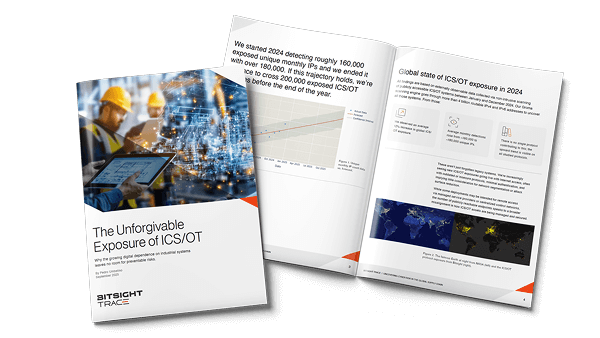
In Bitsight TRACE’s The Unforgivable Exposure of ICS/OT, Pedro Umbelino estimated that the number of exposed ICS/OT devices would reach 200,000 by the end of 2025. In the U.S. alone, there are 80,000 exposed ICS/OT devices, followed closely by 75,000 in Italy. This represents a reversal in the previous downward trend; in fact, Bitsight TRACE observed a 12% increase in exposures.
While ICS/OT vulnerabilities may not feel like an ‘us’ problem, it very much is.
At first, losing them does not seem like a big deal.
A traffic light is out. A gas pump does not work. A card reader fails. These feel like inconveniences, not crises. Small problems that people assume will be fixed soon.
But minutes turn into hours, and hours turn into days. The consequences begin to stack.
Refrigerators warm. Insulin spoils. Vaccines go bad. Water pressure drops. Backup generators start their countdown. People cannot pay for their groceries. Phone lines go silent. Bank accounts are inaccessible. The internet no longer works.
What felt temporary becomes permanent far faster than anyone expects.
The world does not end with a bang. It ends when the lights do not come back on. When even backup generators run out of gas.
What follows is not science fiction. It is what happens when the systems we rarely see—industrial control systems and operational technology—stop working.
Day 1
00:00–06:00 | The silence
Sometime after midnight, power grids begin to fail. Not everywhere. Not all at once. Most people sleep through it. Cell towers hum on backup generators. Hospitals switch to emergency power. Elevators stop between floors. Data centers shut down cleanly at first.
Nothing looks broken yet. There are no alerts, no panic, no headlines. Just systems going quiet.
What this means:
Industrial systems fail silently. By the time people notice, the failure is already widespread.
For energy and utilities, this is loss of visibility and control, not just loss of service.
For telecommunications, backup power becomes a race against time.
For companies, this is the moment when an operational issue becomes a business crisis without warning.
06:00–09:00 | The false morning
People wake up late.
Phones are dead. Alarm clocks never rang. It feels personal, like a device problem.
Traffic lights are dark. Drivers negotiate intersections with eye contact. Gas stations are open but useless. Pumps do not turn on. Cards do not swipe. The downfalls of a cashless society become undeniable.
Coffee shops unlock their doors out of habit, then close again. ATMs show blank screens.
Everyone assumes this is temporary.
What this means:
Modern life depends on OT systems that do not degrade gracefully.
For transportation and smart city operators, traffic control failures immediately create physical danger.
For oil and gas and fuel distribution, availability of fuel depends entirely on powered control systems.
For retail and financial services, transactions stop even when goods and cash still exist.
Downtime stops being an inconvenience and starts becoming a risk.

09:00–12:00 | When the cold starts to fade
Grocery stores close quietly.
Registers do not work. Inventory systems are unreachable. Freezers hum for a while, then fall silent.
In homes, people open refrigerators just to check. Cold air spills out. Doors close. The clock speeds up.
In hospitals and pharmacies, the stakes are clearer.
Insulin.
Biologics.
Chemotherapy drugs.
Vaccines.
Medications that do not just expire, but fail.
Nurses consolidate refrigerators. Pharmacists tape handwritten signs to doors. Some medications are already unusable.
Hospitals slowly run out of lifesaving supplies.
What this means:
Cold storage is not a convenience. It is a life-support system.
For healthcare, refrigeration and power stability directly determine patient survival.
For pharmaceutical manufacturers and distributors, cold chain failure becomes a liability within hours.
For food and grocery retailers, spoilage is immediate and unavoidable.
For individuals who rely on insulin or biologics, the outage turns chronic conditions into emergencies.
12:00–15:00 | Heat, hunger, and time
In warm climates, apartments turn into ovens.
Nursing homes become dangerous.
Water pressure drops as pumping stations struggle. Boil-water advisories are issued, then ignored. There is no power to boil anything.
Food softens. Milk sours. Meat sweats.
People begin counting medication doses.
How long does insulin last without refrigeration?
Who else might still have power?
The first deaths do not make the news.
Heat stroke. Missed medications. Equipment failures.
What this means:
Public health depends on industrial systems that were designed decades ago.
For water and wastewater utilities, OT failure immediately becomes a public health emergency.
For real estate and property management, habitability disappears without climate control.
For employers, workforce safety extends beyond the office when infrastructure fails.
This is where resilience stops being theoretical and starts being measurable in lives.
15:00–18:00 | The human shift
Traffic accidents multiply.
Police radios work sporadically. Dispatch does not.
Fire departments respond to what they can reach, not what is worst.
People knock on neighbors’ doors.
Do you have batteries?
Do you have ice?
Do you have refrigeration for insulin?
Some doors open. Some do not.
Communities begin forming around whoever has power, fuel, or medical knowledge.
What this means:
When formal systems fail, informal ones replace them.
For public safety organizations, operational dependence on OT determines response capability.
For employers and large organizations, employees become community members first and workers second.
For critical infrastructure operators, trust becomes local and fragile.
Inequality becomes visible fast.
18:00–21:00 | Nightfall
The sun goes down, and the city disappears.
No skyline. No ambient light. Candles flicker against walls.
Stores with remaining supplies are stripped bare. Not riots, just quiet desperation.
Gunshots echo farther than expected.
Hospitals lose generator fuel.
Insulin spoils in dark refrigerators.
Cold-chain medications fail silently.
Doctors make decisions they were never trained for.
What this means:
Backup systems are not solutions. They are countdowns.
For healthcare providers, generator fuel and load management become life-and-death constraints.
For logistics and supply chain companies, fuel and transport failures compound rapidly.
For manufacturers, production stops long before facilities are damaged.
Once night falls, recovery becomes exponentially harder.
21:00–00:00 | The new normal
Phones are dead. Silence settles in.
Families sit together without distraction, without updates, without reassurance.
Candles burn low.
People plan for tomorrow using guesses.
Some realize their food lasts days.
Some realize their medication lasts hours.
Some realize their city lasts less than a week.
The world did not end today.
It just stopped working.
What this means:
ICS and OT systems succeed because they are invisible. That invisibility is also their greatest risk.
For companies, this is where operational risk becomes existential risk.
For governments, this is where infrastructure protection becomes population protection.
For individuals, this is where dependency becomes clear.
Why this matters across industries
ICS and OT security is not a niche technical concern.
It determines whether insulin stays cold.
Whether water flows.
Whether fuel moves.
Whether hospitals function.
Whether cities remain livable.
When these systems fail, society does not collapse loudly.
It collapses quietly, one refrigerator, one pump, one generator at a time.
And once that clock starts, there are no patches.
The end.
This is not science fiction. It is a very real threat to modern society.
We rely on industrial control systems and operational technology to deliver our most basic necessities. Power, water, fuel, healthcare, food, and communications all depend on systems that were often designed decades ago, long before today’s threat landscape existed.
Many of these systems were built to run in isolation. Today, they are remotely accessible, interconnected, and increasingly exposed. That makes them targets.
Threat actors are not just going after data. They are targeting devices that control physical processes, key resources, and critical infrastructure. When those systems fail, the impact is not digital. It is human.
This is why ICS and OT security matters. Not because of headlines or hypotheticals, but because these systems are the quiet foundation of everyday life. When they stop working, the consequences compound quickly, and recovery is never simple.
The risk is real. The clock starts ticking the moment control is lost.