The enterprise attack surface now extends well beyond the network firewall. As a result, Third Party Risk Management Teams are increasingly becoming an extension of Security Operations Centers, responding in times of crisis to questions of who, what, and more urgently, how and when. The line between ‘their exposure’ and ‘our risk’ is almost non-existent.
But bridging the gap between data and platforms can be challenging. In many cases, even the tools and systems that look at 1st party exposure are different from those that monitor 3rd and 4th party vulnerabilities (if they exist at all).
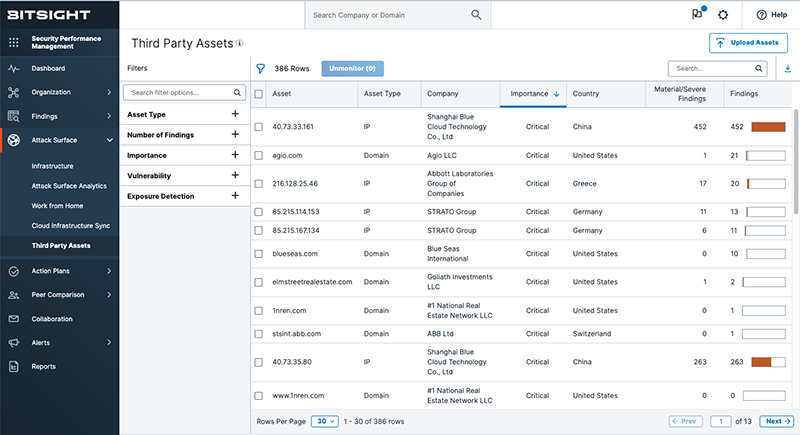
Our latest Continuous Monitoring enhancement - Critical Asset Management - is a result of direct customer feedback asking to help bridge this gap. It’s the next step on our journey to provide a unified view of the attack surface, furthering visibility into the most critical third-party IPs and domains alongside your view of your own network and externally facing infrastructure.
Key Takeaways
- As the attack surface expands, third-party risk teams need the capability to drill down into the specific risks at the intersection of their business and vendors.
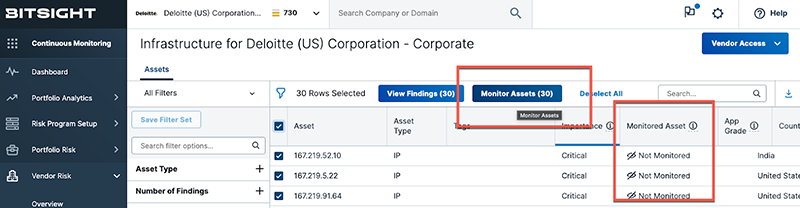
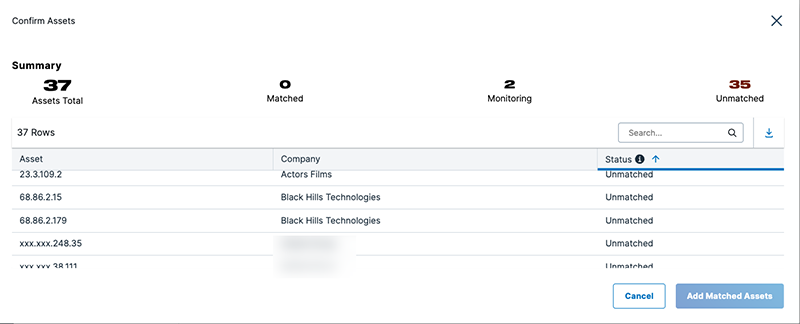
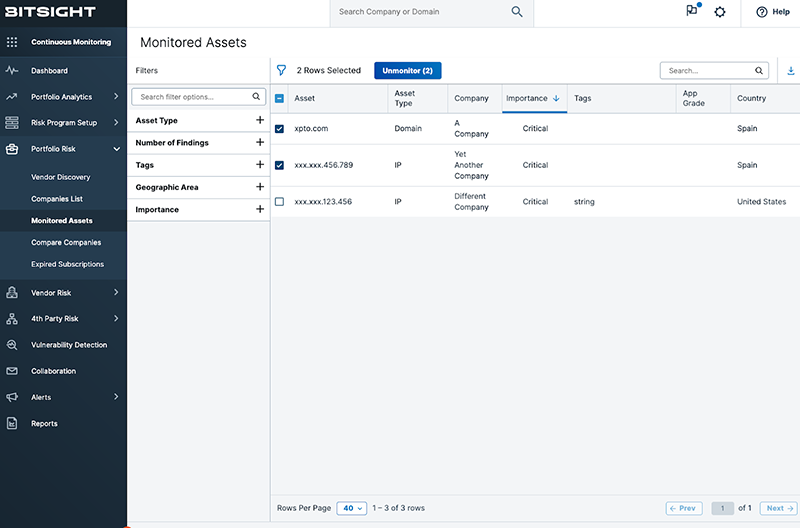
- Bitsight’s new Critical Asset Management enhancement makes it easy to target specific third-party assets for continuous monitoring–individually or in bulk.
- Prioritized monitoring ensures that an organization’s limited security resources are focused on the assets with the greatest impact on third-party risk posture.
- Critical Asset Management is now available to all Bitsight CM customers at no additional cost.
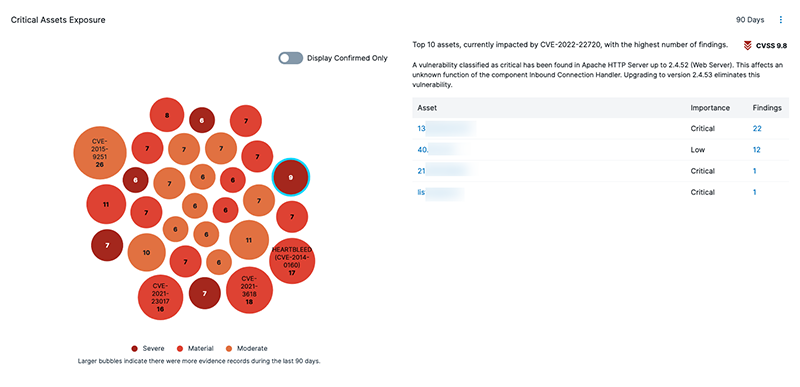
- Via the Bitsight EASM module, third-party critical assets become visible to the Security Operations team, enabling collaboration and transparency.
Identifying the most critical third-party risk with an asset-level approach
As organizations strengthen internal exposure management, the extended attack surface—shaped by their vendor ecosystem—demands a more precise, "focus-on-what-matters-most" approach. Rather than assessing vendors' overall exposure and risk, third-party risk teams can zero in on the most critical intersections—the specific services vendors provide, represented by key IPs and domains. This targeted approach improves prioritization and is especially valuable in time-sensitive situations, such as responding to zero-day vulnerabilities. By monitoring vendors at the asset level, teams can act faster on risks that directly impact their organization, ensuring resources are allocated where they matter most—without treating all vendor assets equally.
This refined approach moves beyond general vendor monitoring, enabling security teams to prioritize investigations and drive urgency where it matters most. Instead of treating all vendor assets equally, they can focus on the most relevant relationships, improving visibility, streamlining communication, and making risk management more actionable—without adding unnecessary noise.
When it comes to prioritizing your critical third-party assets, this will be based on a variety of factors. For example, third-party vendors generally have varying levels of strategic importance or potential risk. After all, an ecommerce vendor that your company buys office supplies from does not pose the same level of risk as a strategic technology integration partner that provides behind-the-scenes functionality for one of your customer-facing applications. So, while both third-party risk vectors should be identified and understood, the level of ongoing focus on each should not be the same.
The same may be true within a specific vendor’s asset inventory. Vendor assets that have a more direct touch point with your business and IT infrastructure warrant a higher level of focus as part of your third-party risk management strategy.