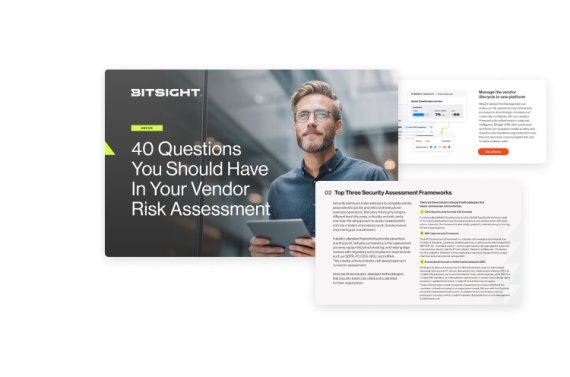
With this ebook, we'll help you prioritize which vendors need the most attention with an in-depth security assessment – such as those with low security ratings, or critical vendors that maintain constant contact with your company’s systems.
Third-Party Risk Management Policy
What is a TPRM policy?
A third-party risk management policy is a structured framework that outlines how an organization identifies, assesses, manages, and mitigates risks associated with its external vendors and suppliers. These third-party relationships, while essential to business operations, can significantly expand an organization’s cyber risk exposure. Effective third-party risk management (TPRM) policies are crucial for reducing vulnerabilities, safeguarding sensitive data, ensuring regulatory compliance, and ultimately maintaining business resilience.
A comprehensive third-party risk management policy serves as a foundational document that guides an organization's security posture concerning its vendor ecosystem. It clearly communicates expectations internally and externally, supports accountability, and helps align third-party management processes with broader business goals.
The importance of vendor risk management policy
If you’re experiencing frustrating delays and procedural roadblocks during your vendor management process, you’re not alone. Security managers are seeing an increase in the number of third parties integrating with their business, and Gartner reports that “60% of organizations are now working with more than 1,000 third parties.”
The problem lies in inefficient programs that can’t handle the onslaught of new vendors from relying on manual coordination with the right business departments needed to manage a vendor. Onboarding, sometimes dreaded by those on a company’s security team or legal department, requires resources and cooperation from both the organization and the vendors to ensure the proper documentation and data is communicated between the two companies.
The organization is responsible for properly evaluating a third party during onboarding to ensure their processes are aligned. Whatever a company misses during onboarding is on them, which is why time is taken to cover all the bases. Onboarding does not have to be a time consuming and costly process if security leaders have the right vendor management policies in place to work together with their business teams.
Key components of third-party risk management policy
An effective TPRM policy should include the following critical components:
- Clearly defined roles and responsibilities to ensure accountability, from risk analysts and procurement teams to senior executives
- Standardized vendor assessment procedures that provide consistent criteria for evaluating third-party security posture, leveraging objective data, such as continuous monitoring results, to validate vendor responses
- Defined risk categorization criteria to prioritize vendors according to their potential impact on security and compliance
- Continuous monitoring for real-time insights into vendor security performance, enabling rapid response to emerging threats
- Incident management procedures to swiftly address third-party security breaches or vulnerabilities, minimizing business disruption
Integrating TPRM into broader enterprise risk management and governance programs is a critical best practice. This holistic approach ensures that third-party risks are not managed in isolation but are instead contextualized within the organization's overall risk profile and business objectives. Regularly reviewing and updating the policy to adapt to evolving threats, technological changes, and regulatory requirements ensures ongoing effectiveness and relevance.
Third-party risk management policy template
Implementing a consistent and thorough third-party risk management policy can be streamlined through a well-structured template. Such a template typically includes sections such as:
- Scope and objectives
- Roles and responsibilities
- Risk assessment procedures
- Vendor categorization
- Monitoring and continuous evaluation
- Incident response protocols
- Regulatory compliance requirements
This template should be adaptable to an organization’s specific risk tolerance and business objectives, making the complex task of policy creation more efficient.
Leveraging pre-existing, robust templates provided by cybersecurity risk management platforms like Bitsight can accelerate policy development. These templates often integrate evidence-based cyber risk intelligence, automating the assessment and onboarding processes, thus improving both speed and reliability in vendor evaluations.

Where can you adapt your TPRM policy process?
As part of the procurement process, it is a security professional’s job to evaluate potential vendor’s security position and management. When someone on your company's HR team comes to you with a new, potentially cheaper vendor to manage employee benefits, what are the policies that come into play? Maybe the first step is pulling up the standardized document of “new vendor due diligence” requirements and forwarding it to the vendor, or discussing the budget for new vendors with the finance team. These steps are common in many organizations when it comes to vendor management.
Just because there are common vendor onboarding strategies doesn’t always mean they are the most efficient way to go about the process. What if there were security standards set before a third party was even introduced to a company that would eliminate them from consideration? Including security guidelines as your policy for new vendors that are available across the organization enables the business by keeping cybersecurity at the forefront of third-party risk management.
Establishing a risk tolerance
Deciding on what the maximum risk you’re willing to take with a vendor will help narrow down the list of vendors to evaluate, giving the security team back some of the time they spent evaluating vendors. Instead of spreading their resources thin, security professionals can focus deeper on the companies that matter to them.
One way to establish the risk you're willing to take with your vendors, as well as how to keep that standard even across all departments, is through a security rating. Bitsight for Third-Party Risk Management provides an external, objective view into a vendor’s cybersecurity to help users obtain a real, trusted view of their third parties.
Bitsight allows users to compare their third parties’ security ratings, even when the companies have experienced different types of cybersecurity events. If a company can use a Bitsight security rating to weed out third parties who fall below the allowed risk threshold, the vendor selection and onboarding process can be narrowed down to only companies that have secure systems in place.
Setting tiers to enable easier onboarding
Finding a risk threshold your organization is comfortable with for new vendors is a great way to implement efficient vendor management policies. An impactful step you can then take to further enable your third-party risk program to grow and properly manage your vendors is to tier your third parties based on risk and criticality.
Vendor criticality is one factor to consider when deciding on the inherent risk a third-party holds, and can also be used to help group your vendors into easy-to-manage tiers. Tiering your third parties will group all of your existing vendors into tiers based on how close they are to sensitive company information. With Bitsight, organizations can see a suggested tier for each vendor determined by the nature of the third party and how risky their cybersecurity standings are.
Policy change as a result of tiering
When a company tiers their vendors, they can then implement policies for all vendors that fall into specific tiers, removing the inefficiencies when certain vendors are over-assessed or under-assessed. Top-tier vendors might require continuous monitoring of their cybersecurity standings to prevent malicious activity before it happens, because even a slight breach in their systems could lead to major damage to the companies they’re operating with. Lower-tier vendors might only need to be evaluated when a breach is detected.
Where the third party falls in your organization’s tiering system can help determine the level of vendor risk assessment they require. Tiering removes excessive work on vendors that don’t require it so that the same resources can be used to better manage top-tier vendors.
Where you’ll see improved efficiency
Finding the right third-party management policies can make a huge difference on program efficiency, which in turn allows the company as a whole to function without cybersecurity as a roadblock. The right vendor management policies will save the company money by speeding up the process of onboarding vendors using their Bitsight security rating. Security ratings allow companies’ security programs to be compared with each other because they are calculated looking at the same types of data and independent of the size of the organization.
Tiering and using risk thresholds creates a standard way of looking at a vendor across all company units because everyone who deals with vendors is clear on what the company risk tolerance is. When everyone is on the same page there is limited room for confusion or need for multiple meetings when working with a new vendor. Implementing the right vendor management policies will allow your security team to do more with the same resources they already have.
Transform your vendor management policy
Many businesses are being forced to accept change in their processes already with the new pandemic-focused world. While you are already experiencing change in your business, now is a great time to introduce cybersecurity policies that highlight efficiency and can save your organization time and money.