When Bitsight introduced security ratings in 2011, it pioneered what soon became the standard for measuring cybersecurity performance. Today, with a growing number of providers offering their own rating solutions, Bitsight remains the industry standard, trusted by leading enterprises, government organizations, and businesses of all sizes to objectively assess cybersecurity posture and make more informed risk decisions.
But how do Security Ratings work, and what has kept Bitsight at the forefront of the industry for over 15 years?
What are security ratings?
Security ratings are independent, continuously updated assessments of an organization’s cybersecurity performance, based on externally observable security data.
By continuously analyzing vulnerabilities, compromised systems, security configurations, and historical security performance, security ratings provide a more reliable picture of an organization’s security posture than point-in-time assessments.
What are Bitsight Ratings?
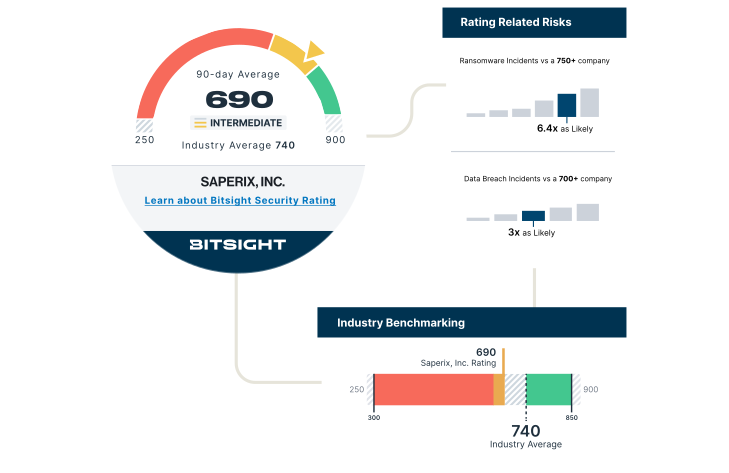
Think of Bitsight Ratings like a credit score, but for a business’s security performance. Like credit scores, Bitsight Security Ratings range from 250 to 900, with higher ratings indicating better cybersecurity performance. CISOs, CIOs, security managers, insurance underwriters, auditors, and many others can use these ratings to:
- Understand their own security performance, as well as the performance of their vendors, clients, and other third and fourth parties
- Continuously assess cyber risks across their third-party supply chain and entire digital ecosystem
- Make faster, data-driven cyber risk management decisions relying on objective data
Bitsight Ratings are updated daily and can be easily accessed in the Bitsight platform.
What goes into the Bitsight Security Rating calculation?
Bitsight calculates Security Ratings using petabytes of data and billions of daily observations from more than 100 sources, including proprietary collection tools and infrastructure (such as Bitsight Groma) and specialized data partners.
This data is then evaluated across 23 risk vectors measuring different aspects of security performance, including:
- Compromised systems: Evidence of botnet infections, malware servers, and other indicators of compromise
- Security diligence: How effectively an organization follows cybersecurity best practices, including software patching, vulnerability management, email security, SSL/TLS configurations, and network security
- User behavior: Potentially risky activities, such as peer-to-peer file sharing
- Public Disclosures: Reports of security incidents including data breaches, ransomware attacks, and other cybersecurity issues.
These findings are mapped to an organization's digital footprint, including its IP addresses and domains, before being evaluated based on their severity, frequency, and duration with a scoring methodology accounting for organizational size, historical security incidents, and performance relative to other organizations.
The result is a Security Rating that is updated daily, allowing security leaders to identify weaknesses, benchmark security performance, and track improvement over time.
Bitsight also follows (and helped develop) the U.S. Chamber of Commerce’s Principles for Fair and Accurate Security Ratings. These principles promote transparency in how ratings are calculated, accuracy through data-driven validation, and independence from commercial relationships. They also establish clear processes for disputing and correcting ratings, governance over methodology changes, and safeguards for confidential information. Following these standards helps ensure that Bitsight Security Ratings remain objective, reliable, and trustworthy.
How to use Bitsight Security Ratings
Bitsight Security Ratings help organizations make smarter, more informed decisions across a range of security and business use cases.
Assess and improve security posture with Bitsight SPM
Bitsight Security Posture Management (SPM) uses Security Ratings to help organizations objectively measure, benchmark, and improve cybersecurity performance. By combining ratings with attack surface visibility, threat intelligence, and business context, Bitsight SPM helps organizations:
- Measure and improve security posture: Establish a baseline, monitor exposures, and track the effectiveness of remediation and security controls over time.
- Benchmark against industry peers: Compare Security Ratings with peers, competitors, and business units.
- Communicate security performance to stakeholders: Use Security Ratings and performance trends to provide evidence-backed reporting to executives, to guide security investments.
- Support cyber insurance decisions: Provide insurers with objective evidence of cybersecurity posture and improvements for better underwriting decisions and policy terms.
- Assess cyber risk during mergers and acquisitions: Evaluate acquisition targets' security posture, identify potential exposures, and inform due diligence and integration planning to reduce inherited cyber risk.