Cybersecurity Burnout’s Secret Trigger: Lack of Visibility

cybersecurity burnout in 2025 blog
Chris Campbell
Written by Chris Campbell
Senior Vice President, Chief Information Security Officer, and Head of Technology

The work of a cybersecurity professional never ends, and it’s never easy. Whether they’re responding to incidents in the SOC or briefing the board on supply chain vulnerabilities, security leaders and practitioners live under constant pressure. And while the reality of burnout may not be new, it’s still a growing threat. One that endangers not only the well-being of security professionals but also the resilience of the organizations they protect.

But cybersecurity burnout doesn’t have to be inevitable. Data from Bitsight’s 2025 State of Cyber Risk and Exposure report suggests that organizations that improve their visibility into risk—and the ability to prioritize what matters most—can make measurable progress in supporting the mental health and effectiveness of their teams.

The state of cyber burnout in 2025

In our survey of more than 1,000 risk and security professionals, 47% reported that they or their staff are experiencing some level of burnout. More than one in ten described their condition as acute, either very burned out or on the verge of leaving the profession altogether.

These findings echo other industry research. Proofpoint’s 2025 Voice of the CISO report found that 63% of CISOs experienced or witnessed burnout in the past year. Sophos’ The Human Cost of Vigilance put that figure even higher, at 76%. The exact number may vary, but the conclusion remains the same: cybersecurity work is reaching unsustainable levels of stress, and ignoring this reality will lead to weaker security outcomes.

Burnout doesn’t just harm individuals: it erodes the performance of entire programs. According to the Sophos study, 39% of professionals reported that burnout reduced their productivity, and 33% said it reduced their engagement at work. Those are leading indicators of organizational risk.

Building resilience starts with clarity, not headcount

So how do we move the needle on burnout in a profession that isn’t getting less stressful anytime soon?

Hiring more people helps, but it’s not the whole answer. As you would expect, smaller teams shoulder a heavier burden and are twice as likely to experience burnout. Yet even in well-staffed programs, nearly one in four professionals said they’re feeling it, too.

Given today’s economic headwinds and stalled cyber hiring initiatives, simply adding headcount isn’t always realistic—or sufficient. Burnout often stems not from the amount of work, but from the lack of clarity around what matters most.

The visibility:burnout connection

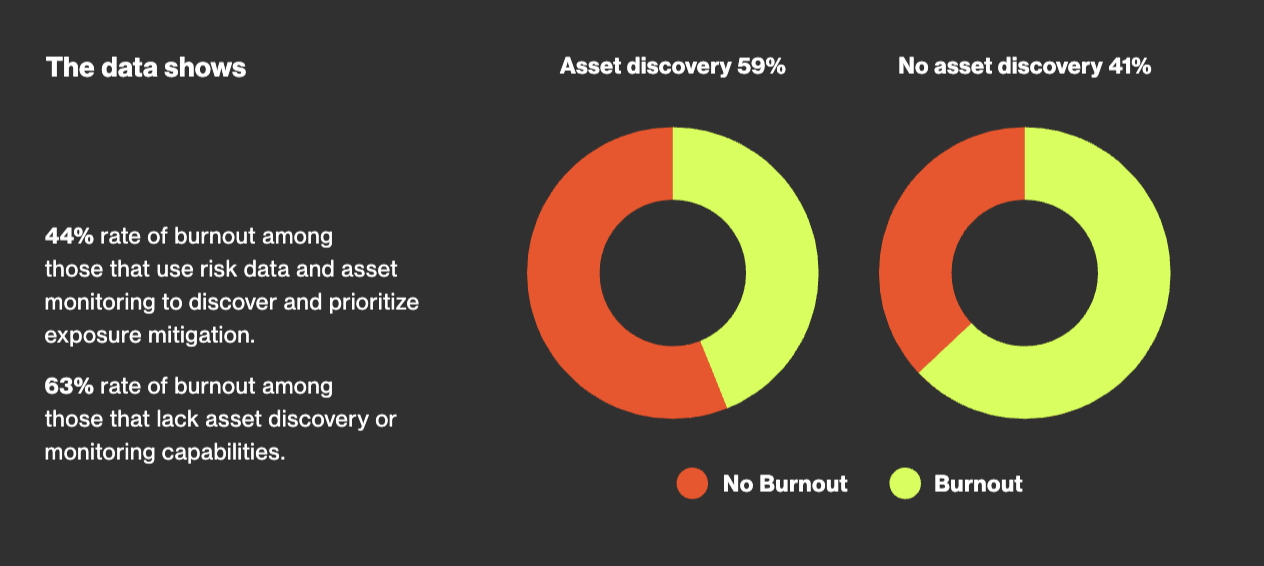
When we examined the underlying conditions behind burnout, one factor stood out: visibility. The ability to see, understand, and prioritize risk directly correlates with mental resilience among cybersecurity teams.

  • 63% burnout rate among organizations that lack asset discovery or monitoring.
  • 44% burnout rate among organizations that use risk data and asset monitoring to discover and prioritize exposure mitigation.
rate of burnout in cybersecurity survey

Those are striking differences. But the story doesn’t end there. Organizations that go further—including continuously monitoring assets, mapping threats across environments, and contextualizing data with business impact—see burnout rates drop even lower, to 32%.

While these findings are correlational, the implication is powerful: visibility doesn’t just strengthen security posture; it strengthens the people behind it. When teams can clearly see what matters most, prioritize effectively, and demonstrate progress, they gain control over chaos—and that control is a direct antidote to burnout.

Visibility as a leadership advantage

Visibility is more than a technical capability—it’s a leadership imperative. It enables CISOs to focus resources where they matter most, communicate confidently with boards, and give their teams a clear sense of direction and purpose.

That’s why at Bitsight, our own security and risk teams have made continuous visibility a cornerstone of daily operations. By using the same exposure data and prioritization models we provide to customers, we ensure our teams stay aligned on the highest risks and can act with confidence.

Burnout thrives in uncertainty. Visibility creates clarity. And when security leaders operate with clarity, teams become more decisive, boards more informed, and organizations more resilient.

Because in cybersecurity leadership, visibility doesn’t just show you risk: it shows you the path forward.

Trace Sate of Cyber Risk 2025 Report No background

90% Say Cyber Risk Is Harder Now—Discover Why

The 2025 State of Cyber Risk and Exposure report reveals why security leaders are under pressure: AI-driven threats, expanding attack surfaces, and misalignment with business priorities. Based on global survey data, it surfaces the root causes behind today’s risk fatigue—and what mature organizations are doing differently.