Email is a well-known and widely used attack vector for malware distribution, phishing, and many other types of threats. For this reason, we evaluate certain email security practices as part of the Diligence category of risk vectors used to calculate Bitsight Security Ratings.
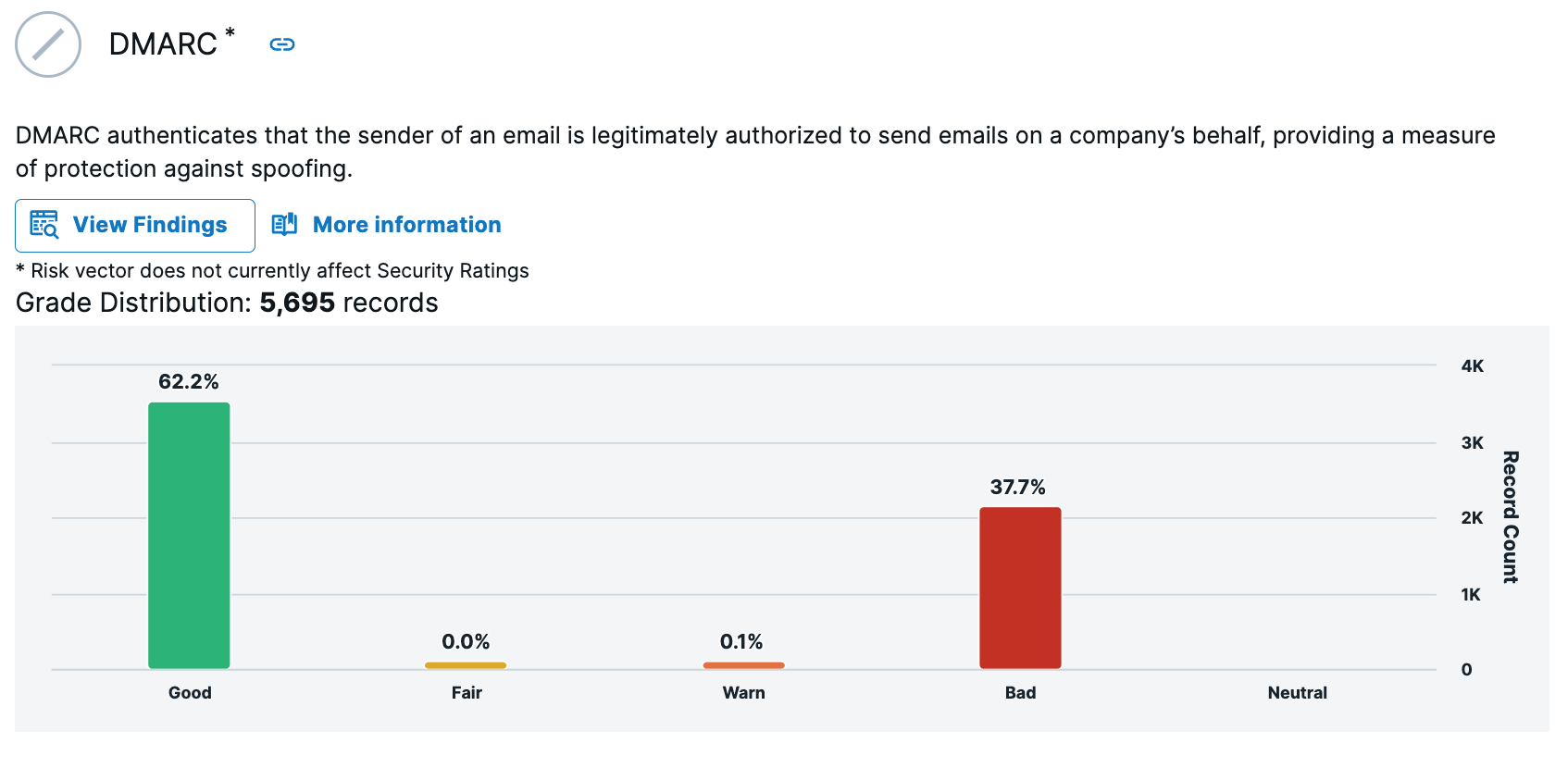
On April 30, 2024, we added a new email security evaluation focused on the use of Domain-based Message Authentication, Reporting, and Conformance (DMARC) records. DMARC evaluation is initially included as a non-graded risk vector and will not impact Bitsight Security Ratings at this time.
Here are some further details about this enhancement, why we made it, and what it means to your organization.
How has Bitsight evaluated email security previously?
Historically, Bitsight has evaluated the email security practices for specific domains by reviewing the usage of two commonly used DNS record types:
Sender Policy Framework (SPF) Records
SPF records identify mail servers permitted to send email on behalf of a domain. Bitsight looks for properly configured SPF records for all an organization’s domains, even if they aren’t used to send email. This is a best practice, since threat actors may attempt to spoof email from a domain even if the organization does use it for email themselves.
DomainKeys Identified Mail (DKIM) Records
DKIM records provide an additional level of protection against email spoofing by using public key cryptography to verify the authenticity of email messages. Bitsight looks for properly configured DKIM records that ensure that email messages have not been altered in transit and originate from the claimed source domain.
These evaluations are performed through automated scanning, and findings for both have a lifetime of 60 days.
What is DMARC, and how does it work?
DMARC is an email authentication protocol that builds on SPF and DKIM by giving domain owners greater control over email authentication, including:
- Requiring either SPF or DKIM to pass in order for email to be considered authenticated
- Allowing domain owners to specify the action mail servers should take when authentication fails, such as rejecting or quarantining the message
- Providing the ability to request authentication statistics from receiving mail servers to review the effectiveness of their implementation
This additional level of control, when configured effectively, provides enhanced protection against phishing and other email-based threats.
For a more detailed explanation and real-world examples of how proper DMARC usage reduces email risk, check out “Domain (in)security: the state of DMARC” for a deeper dive into this topic by the Bitsight Research Team.
What is driving DMARC adoption?
Major email providers like Google, Yahoo, and Apple are taking steps that will accelerate the transition of DMARC from best practice to a must-have email configuration. For example, Google implemented a new set of requirements on February 1, 2024, that requires all organizations that send more than 5,000 messages per day to Gmail users to have a DMARC policy in place. They also noted that they will be using a DMARC quarantine policy moving forward for messages sent from Gmail addresses.
Yahoo and Apple have introduced similar policies. While these changes are initially focused on bulk email senders, they apply to many email marketing platforms used in the business setting. These actions by top email providers also likely represent a major step towards broad-scale adoption of DMARC for all types of email delivery.