Third-Party Data Sharing
Your vendors and partners are key to helping your organization keep pace with digital transformation, increase efficiencies, and stay one step ahead of the competition. But your organization’s vendor ecosystem is also a complex and interconnected supply chain. It’s likely you deal with dozens if not hundreds of vendors, many of whom handle sensitive data.
Sensitive data sharing is an unavoidable risk that must be managed. That’s because malicious attackers tend to look for the weakest link in an organization’s security posture – which often resides in its supply chain. As such, it’s critical that your company has full visibility into the cybersecurity health of each vendor’s entire network of digital assets, remote access points, and cloud providers.
As you develop and refine your third-party risk management program, consider the following do’s and don’ts for sharing sensitive data.
Sensitive Data Sharing: "To-Do" List
1. Understand the value of your data prior to allowing a third-party to access it.
Being able to differentiate data that is highly sensitive from data that is only moderately sensitive is an important step. To help you determine the sensitivity of your organization’s data, here are 5 Examples of Sensitive Data and How You Can Protect Each.
2. Only share the minimum information your vendors need.
If, for example, your vendor will be monitoring your HVAC system remotely, you must ensure they only have access to the part of your network that controls your HVAC and nothing more. The key is to limit your exposure as much as possible.
3. Tier your vendors based on how closely they work with sensitive data.
Instead of assessing all vendors in the same way, tier your vendors based on how closely they work with company data. Prioritize those in the top tier (such as payroll vendors and cloud service providers) instead of wasting resources on lower-tier vendors that don’t have sensitive data sharing agreements with your business.
4. Create security expectations for your vendors.
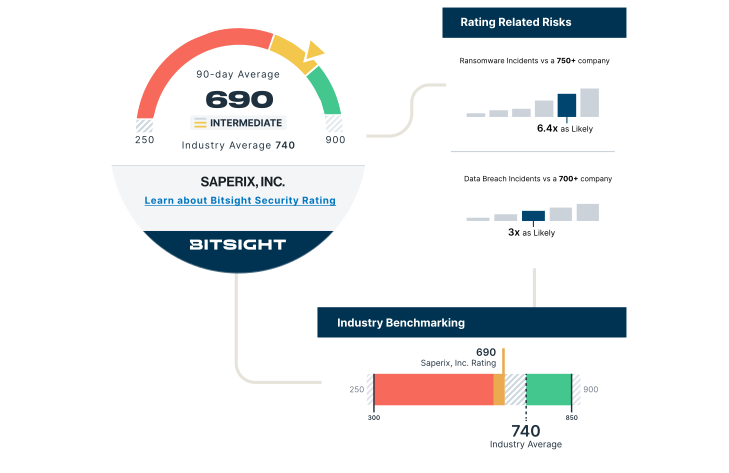
These expectations shouldn’t be casually mentioned at the beginning of a business relationship, but rather cemented into your vendor contracts. Make these expectations legally airtight so your mind—and the minds of those in upper management—can rest at ease. For instance, Bitsight for Third-Party Risk Management—which relies on the Bitsight Security Ratings platform—allows you to set clearly defined baselines for acceptable risk. If a vendor’s security rating dips below an established threshold, you can reach out to the vendor, share Bitsight’s findings, and collaborate to mitigate cyber risk.
5. Establish an incident response plan.
Develop a procedure that requires your third parties to notify you in the event of a cybersecurity incident. Typically, this is a written procedure that is referenced in the contract outlining who the third-party must contact if a security breach occurs and when that communication will happen. But instead of reacting to such an incident, you can also get one step ahead of cyber risk in your supply chain by continuously monitoring the security posture of your vendors with Bitsight for Third-Party Risk Management. If a cyber incident occurs or a vulnerability is discovered that could lead to a data breach, you’ll get instant alerts. This allows for faster intervention, quicker risk reduction, and greater peace of mind. Continuous monitoring also limits risk exposure that can arise between traditional security audits and assessments that only provide a point-in-time snapshot of a vendor’s security profile.