Most organizations are accustomed to benchmarking certain business areas like sales, profits, and resource allocation. These areas all have one thing in common — they are easily measured with simple, quantifiable metrics.
Cybersecurity, on the other hand, has not been so simple to quantify. An organization might attempt to benchmark their security performance, but if they rely on highly technical or point-in-time indicators, then their security benchmarks likely won’t be very useful.
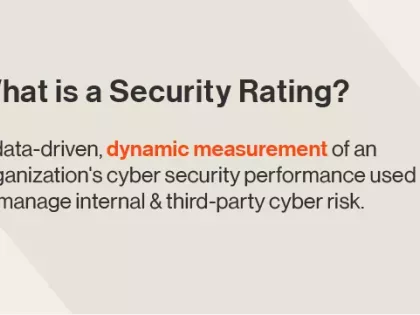
Thankfully, organizations can now use security ratings to benchmark their cybersecurity and create actionable plans for improving security efforts. This type of quantitative and objective data provides organizations with an accurate representation of their external cybersecurity posture. This view enables security professionals to solve specific IT challenges, improve reporting, and receive more resources. These kinds of concrete action items will improve performance and strengthen the position of the IT security team within the enterprise.
Optimizing IT Security Performance
Security ratings provide organizations with a baseline — a cyber security benchmark — with which they can measure their cybersecurity performance against competitors, peers, and across business units. Tracking security ratings over time and comparing them to the security ratings of others enables IT leaders to gain a solid understanding of where their department stands.
Once an organization has benchmarked its security performance, improving security policies and practices becomes a much easier task. Without benchmarking, objectives can devolve into vague promises about “increasing" security or building “better” security architecture. With no concrete performance goals, it becomes difficult to take action or to justify sufficient resource allocation.
Cybersecurity benchmarking helps businesses identify specific areas that need improvement and then makes it possible to track changes over time. Benchmarks also make it clear exactly where a company may be losing ground to competitors. They provide a path to remediate the most crucial security issues while refocusing the overall IT security strategy.
Bitsight Security Ratings are broken down into four primary risk vectors including compromised systems, diligence, user behavior, and data breaches. These categories are then broken down further to inform users of the exact areas where their cybersecurity practices may need some additional attention. IT security teams can remediate issues quickly by leveraging this information to set clear, actionable goals.