Bitsight is moving fast, but we don’t want to sacrifice code quality for speed, which is why tests have always played an important role in our development process. Although we are not doing TDD (Test-driven development), one of the key requirements for doing test heavy development is that the full test suite should be fast. If running all tests takes less than 5 minutes, developers are more likely to run them frequently and keep adding more tests. However, Bitsight's portal application is a bit of a monolith and takes longer than we would like to run test suites.
The Problem
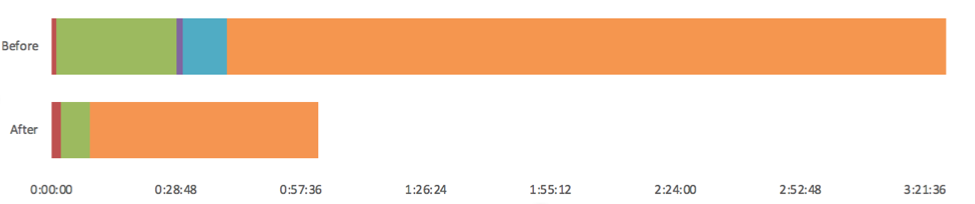
This huge yet important monolith of ours was created over years. We are actively working on breaking it apart. At the same time, we can’t stop making changes to it, and we need to be confident when we do. Fortunately, we have accumulated over 5000 tests of all types — unit tests, integration tests, and user action simulation tests. Some of our recent test runs took up to 3 hours and 26 minutes to complete. Even worse, running a single test took almost an hour. It has finally reached a point that it’s unacceptable, so we decided to take action.
A closer look
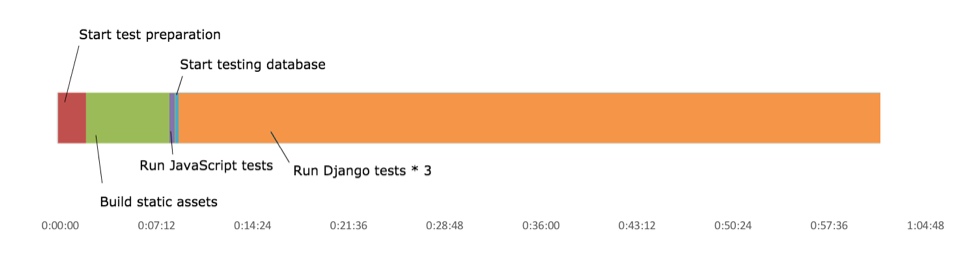
In order to solve this problem, we needed to understand the problem better. Here’s a breakdown of the test run, which initially took 3.5 hours:
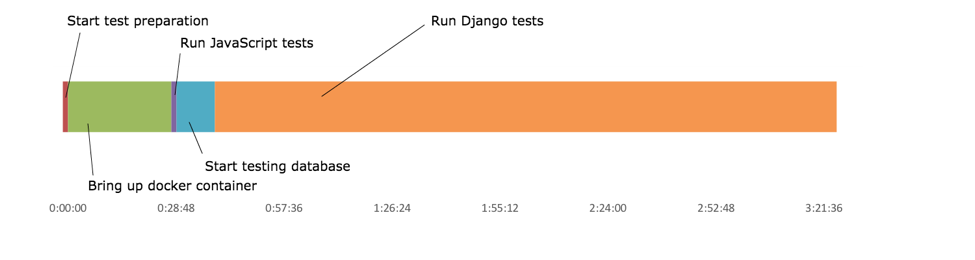
As we can see from the graph, three steps were taking significantly more time than they should: setting up the docker container, starting the testing database, and, of course, the actual test running step. Let’s review them one by one.
Docker Container Setup
Docker is known for being lightweight and agile; so why was it taking around 30 minutes to bring up the container? It turns out we hadn’t been maintaining our docker image at all. Our current image still provided the same environment from when we created it. In order to still be able to run tests, a lot of setup steps, including installing missing python packages, installing node js packages, and building static assets, were introduced as an initializing step of the container every time.
Bitsight’s portal is a python-based application, so we should include and only include the necessary python environment when we build the image, and rebuild it whenever there’s an environment change. Building static assets doesn’t seem to be a reasonable thing to do inside this python image. It should be done in a much more lightweight plain js node container. This should reduce the static assets building time slightly, and the python container setup time a lot.
Django Testing Database Setup
Django is the web framework we use to build Bitsight portal. In this step, the framework initializes the database for running tests. In order to provide consistent testing data we were creating an empty database and loading a pre-defined data fixture. While none of these steps may sound heavy, it takes around 10 minutes in total.
After several testing runs, it caught our attention that when executing a “Rendering models…” step while Django applies migrations, the process would hang there for 5 minutes, and then start applying migrations. A little research unearthed that luck really isn’t on our side — this is a bug in Django. The bug was introduced in an older version, and has been fixed in a later version. Since upgrading the major framework for a legacy monolith wasn’t an option for a quick fix, we had to find another way around.