
CVE-2026-84782 Details
Issue summary: The DTLS retransmission logic does not correctly handle
a handshake message write that is suspended part-way through.
The retransmitted message can be read past the message buffer and
the retransmission overwrites the internal state the suspended write
needs to resume correctly.

Impact summary: The retransmitted message can disclose a heap memory
to the peer as plaintext handshake data or cause a crash and a Denial
of Service when the read reaches an unmapped memory region.

CWE: CWE-125: Out-of-bounds Read

Description: DTLS handshake messages can be written out in multiple
fragments, and a write can suspend mid-message (returning WANT_WRITE)
if the underlying transport temporarily cannot accept more data. While
such a write is suspended, the DTLS retransmission timer may
independently fire and ask the retransmission logic to resend an
earlier, already-acknowledged-as-sent message from its retransmit
queue.

The retransmission logic reused the same internal buffer and position
tracking as the message that was still being written, without
resetting the position back to the start of the message being
retransmitted. As a result the retransmission was read starting from
wherever the suspended write had left off, producing a mislabelled
message whose body was leftover bytes from the other, larger message
still in flight - content that was never meant to be sent at that
point, and which could run past the end of the allocated buffer.

Separately, even when the retransmission is positioned correctly,
allowing it to run to completion while another write is suspended
overwrites the same shared bookkeeping that the suspended write
depends on to resume. When the application later resumes the
suspended write (via a subsequent SSL_read(), SSL_write(),
SSL_accept(), or SSL_connect() call), it finds that bookkeeping in a
state inconsistent with the message and aborts the process in
a debugging build.

The fix resets the retransmission's read position to the start of the
message before resending, and skips retransmission entirely whenever a
handshake write is still suspended, deferring to the next call that
resumes it instead.

FIPS impact: no
The affected code is outside the FIPS module boundary.
View at NVD
Exploit prediction scoring system (EPSS) score for CVE-2026-84782
EPSS (Exploit Prediction Scoring System): EPSS predicts the likelihood that a vulnerability will be exploited in the wild. A higher percentage means a greater chance of an exploit occurring. The EPSS model produces a probability score between 0 and 1 (0 and 100%).
0.83 Probability of exploitation activity being observed over the next 30 days (58th percentile)
CVSS score for CVE-2026-84782
CVSS (Common Vulnerability Scoring System): An open framework owned and managed by FIRST.Org, Inc. that assigns a numerical score from 0 to 10 to software vulnerabilities to indicate their severity.
8.2 High
Products affected by CVE-2026-84782

CVE-2026-84782 Global Footprint

Top 10 Identified Countries

Country Observations Percentage
US 113,259 29.25%
JP 48,435 12.51%
DE 30,168 7.79%
NL 17,104 4.42%
CA 15,452 3.99%
KR 13,492 3.48%
FR 12,623 3.26%
CN 11,383 2.94%
GB 9,965 2.57%
IT 8,945 2.31%

Is CVE-2026-84782 part of your extended attack surface? Bitsight helps security leaders rapidly identify exposure and detect threats in order to prioritize, communicate, and mitigate risk.

View interactive product tours

CVE-2026-84782 Industry Footprint

Top 10 Identified Industries

*Service provider organizations (typically Technology and Telecommunications) are disproportionally represented in the results given their upstream ownership of end-user infrastructure. See our FAQs.

Industry* Observations Percentage
Technology 203,096 75.26%
Telecommunications 41,204 15.27%
Education 11,945 4.43%
Business Services 3,248 1.20%
Government/Politics 3,206 1.19%
Retail 964 0.36%
Energy/Resources 826 0.31%
Media/Entertainment 691 0.26%
Manufacturing 674 0.25%
Utilities 616 0.23%

Bitsight, the leading provider in Cyber Risk Management, introduced the next-generation internet scanner Bitsight Groma in May 2024. This technology continuously scans the entire internet to discover assets, collect asset attribution evidence, and identify an ever-growing set of security observations, such as vulnerabilities and misconfigurations. Groma’s scanning activities presently encompass:


  • 40 million-plus monitored organizations
  • 250 million-plus host names
  • 4 billion-plus routable IPv4 and IPv6 addresses

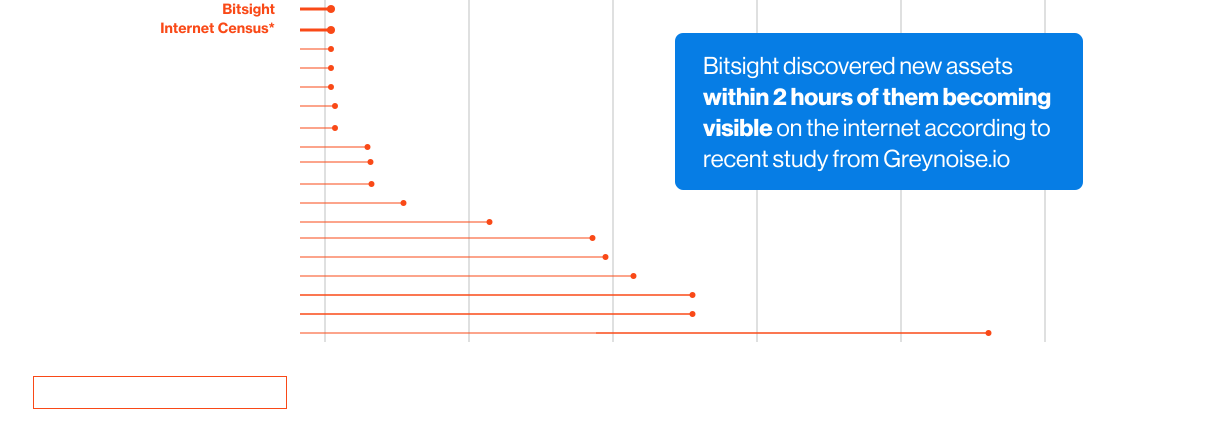
Greynoise’s recent study testifies the speed of Bitsight Groma.
Bitsight data discovery
Governance charcoal background

Bitsight TRACE team investigates security incidents and identifies vulnerabilities and threats.

View latest security research 

See what you’re up against across the expanding attack surface. Prioritize what matters most. And mitigate where you’re most vulnerable.

External Attack Surface Management