
CVE-2026-72897 Details
Issue summary: A TLS server that calls SSL_set_SSL_CTX() to switch a
connection to a different SSL_CTX part way through a handshake may access
memory beyond the end of an internal array if the replacement context knows
about more provider signature algorithms than the context the connection was
created from. Applications which never call SSL_set_SSL_CTX() are not
affected.

Impact summary: A remote peer may be able to cause a small out-of-bounds
read, and in some circumstances a fixed-value out-of-bounds write, on the
server heap. This may lead to a Denial of Service.

CWE: CWE-787: Out-of-bounds Write

Description: A TLS connection records how many certificate slots it has
when it is created, taken from the SSL_CTX that created it: the built-in
certificate types plus one slot for each provider TLS-SIGALG entry that
context was aware of. That count sizes an internal array of per-slot
certificate validity flags.

An application may replace a connection's SSL_CTX part way through the
handshake by calling SSL_set_SSL_CTX(), most commonly from a servername
callback in order to serve a different virtual host. Doing so did not
refresh the recorded count. A provider signature algorithm's slot index is
its position in the list of whichever context resolves it, so if the
replacement context is aware of more of them than the original, an
algorithm offered by the peer can resolve to an index beyond the end of the
array. Processing the peer's signature algorithms then reads one four byte
word past the end for each such algorithm and, where the word read is zero,
writes a fixed value over it. A peer offering many of them can corrupt heap
metadata and abort the process.

Only provider signature algorithms which occupy one of the excess slots,
and which the server also has configured, have this effect. Codepoints the
replacement context does not recognise are discarded without being resolved
to a slot, and provider signature algorithms are usable only from TLS 1.3.

The two contexts must therefore be aware of different numbers of provider
signature algorithms, which requires separate library contexts, a provider
loaded between the two being created, or providers which differ in what
they advertise - in 4.0, for example, the default provider advertises SM2
where the FIPS provider does not. A deployment meeting the condition is
also unable to negotiate the affected algorithms with legitimate clients,
since the same stale count hides the corresponding certificates, so the
misconfiguration is likely to be noticed. For that reason, and because the
configuration is not the default, this issue has been assessed as Low
severity.

FIPS impact: no
No FIPS modules are affected by this issue as the affected code is outside
the OpenSSL FIPS module boundary.
View at NVD
Exploit prediction scoring system (EPSS) score for CVE-2026-72897
EPSS (Exploit Prediction Scoring System): EPSS predicts the likelihood that a vulnerability will be exploited in the wild. A higher percentage means a greater chance of an exploit occurring. The EPSS model produces a probability score between 0 and 1 (0 and 100%).
0.39 Probability of exploitation activity being observed over the next 30 days (33nd percentile)
CVSS score for CVE-2026-72897
CVSS (Common Vulnerability Scoring System): An open framework owned and managed by FIRST.Org, Inc. that assigns a numerical score from 0 to 10 to software vulnerabilities to indicate their severity.
7.5 High
Products affected by CVE-2026-72897

CVE-2026-72897 Global Footprint

Top 10 Identified Countries

Country Observations Percentage
US 31,493 36.17%
DE 8,380 9.62%
NL 7,385 8.48%
JP 7,274 8.35%
GB 2,684 3.08%
CA 2,659 3.05%
FR 2,278 2.62%
IE 2,267 2.60%
DK 2,242 2.58%
IN 1,783 2.05%

Is CVE-2026-72897 part of your extended attack surface? Bitsight helps security leaders rapidly identify exposure and detect threats in order to prioritize, communicate, and mitigate risk.

View interactive product tours

CVE-2026-72897 Industry Footprint

Top 10 Identified Industries

*Service provider organizations (typically Technology and Telecommunications) are disproportionally represented in the results given their upstream ownership of end-user infrastructure. See our FAQs.

Industry* Observations Percentage
Technology 46,279 77.09%
Telecommunications 6,371 10.61%
Education 4,004 6.67%
Government/Politics 777 1.29%
Energy/Resources 517 0.86%
Business Services 385 0.64%
Media/Entertainment 307 0.51%
Utilities 240 0.40%
Manufacturing 212 0.35%
Finance 158 0.26%

Bitsight, the leading provider in Cyber Risk Management, introduced the next-generation internet scanner Bitsight Groma in May 2024. This technology continuously scans the entire internet to discover assets, collect asset attribution evidence, and identify an ever-growing set of security observations, such as vulnerabilities and misconfigurations. Groma’s scanning activities presently encompass:


  • 40 million-plus monitored organizations
  • 250 million-plus host names
  • 4 billion-plus routable IPv4 and IPv6 addresses

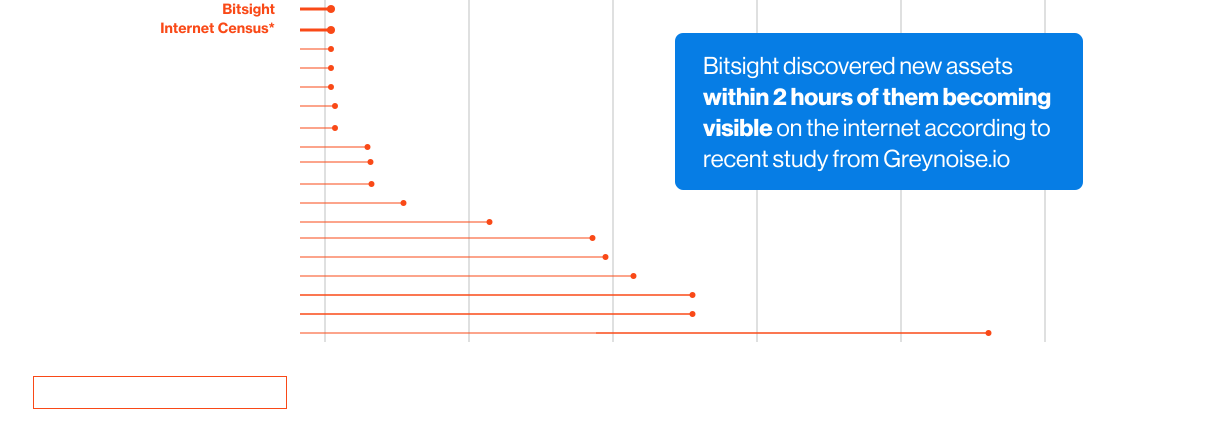
Greynoise’s recent study testifies the speed of Bitsight Groma.
Bitsight data discovery
Governance charcoal background

Bitsight TRACE team investigates security incidents and identifies vulnerabilities and threats.

View latest security research 

See what you’re up against across the expanding attack surface. Prioritize what matters most. And mitigate where you’re most vulnerable.

External Attack Surface Management