
CVE-2026-54874 Details
Issue summary: Receiving a DTLS record for a future epoch while a handshake
is in progress causes OpenSSL to buffer far more memory than the record
itself requires.

Impact summary: A peer can use a small amount of network traffic to make an
OpenSSL DTLS endpoint retain a disproportionately large amount of memory,
which may lead to a Denial of Service.

CWE: CWE-405: Asymmetric Resource Consumption (Amplification)

Description: While a DTLS handshake is in progress, a peer may legitimately
have already moved on to the next epoch (for example, having sent its
ChangeCipherSpec and Finished messages) before the local endpoint has
processed the same transition, typically because of reordering on the
underlying UDP transport. OpenSSL buffers such early records so that they
can be processed once the local endpoint catches up.

Buffering a record currently retains the entire read buffer it arrived in,
which is sized to hold the largest possible DTLS record (around 16
kilobytes), rather than just the bytes that make up the record itself. Up
to 100 such records may be buffered per connection. As a result, a peer
that sends a stream of small forged records claiming to belong to the next
epoch can cause an OpenSSL DTLS endpoint to retain around 1.7 megabytes of
memory, despite sending only a small fraction of that amount of data over
the network.

An attacker therefore gains a memory amplification factor of around 1200,
and can multiply the effect across as many associations as it is able to
open, making this a remote memory exhaustion Denial of Service risk for
DTLS servers. Since the memory retained per connection remains bounded,
and any limit an application already places on the number of concurrent
associations also bounds the total exposure, this issue has been assessed
as Low severity.

FIPS impact: no

No FIPS modules are affected by this issue as the affected code is outside
the OpenSSL FIPS module boundary.

OpenSSL 4.0, 3.6, 3.5, 3.4, 3.0, 1.1.1 and 1.0.2 are vulnerable to this
issue.

OpenSSL 4.0 users should upgrade to OpenSSL 4.0.2.
OpenSSL 3.6 users should upgrade to OpenSSL 3.6.4.
OpenSSL 3.5 users should upgrade to OpenSSL 3.5.8.
OpenSSL 3.4 users should upgrade to OpenSSL 3.4.7.
OpenSSL 3.0 users should upgrade to OpenSSL 3.0.22.

Premium support customers only:
OpenSSL 1.1.1 users should upgrade to OpenSSL 1.1.1zi
OpenSSL 1.0.2 users should upgrade to OpenSSL 1.0.2zr

This issue was reported on 18 May 2026 by Amazon Web Services.
The fix has been developed by Matt Caswell.

-- cut (non-publishing metadata for internal use) --
Reported by: Amazon Web Services
Fixed by: Matt Caswell
View at NVD
Exploit prediction scoring system (EPSS) score for CVE-2026-54874
EPSS (Exploit Prediction Scoring System): EPSS predicts the likelihood that a vulnerability will be exploited in the wild. A higher percentage means a greater chance of an exploit occurring. The EPSS model produces a probability score between 0 and 1 (0 and 100%).
0.52 Probability of exploitation activity being observed over the next 30 days (43rd percentile)
CVSS score for CVE-2026-54874
CVSS (Common Vulnerability Scoring System): An open framework owned and managed by FIRST.Org, Inc. that assigns a numerical score from 0 to 10 to software vulnerabilities to indicate their severity.
7.5 High
Products affected by CVE-2026-54874

CVE-2026-54874 Global Footprint

Top 10 Identified Countries

Country Observations Percentage
US 28,016 28.80%
JP 12,857 13.22%
DE 7,717 7.93%
NL 3,772 3.88%
CA 3,637 3.74%
FR 3,404 3.50%
KR 3,287 3.38%
GB 2,564 2.64%
CN 2,342 2.41%
IN 2,036 2.09%

Is CVE-2026-54874 part of your extended attack surface? Bitsight helps security leaders rapidly identify exposure and detect threats in order to prioritize, communicate, and mitigate risk.

View interactive product tours

CVE-2026-54874 Industry Footprint

Top 10 Identified Industries

*Service provider organizations (typically Technology and Telecommunications) are disproportionally represented in the results given their upstream ownership of end-user infrastructure. See our FAQs.

Industry* Observations Percentage
Technology 51,174 74.96%
Telecommunications 10,387 15.21%
Education 3,212 4.70%
Business Services 1,053 1.54%
Government/Politics 828 1.21%
Energy/Resources 239 0.35%
Utilities 150 0.22%
Manufacturing 147 0.22%
Finance 142 0.21%
Transportation 138 0.20%

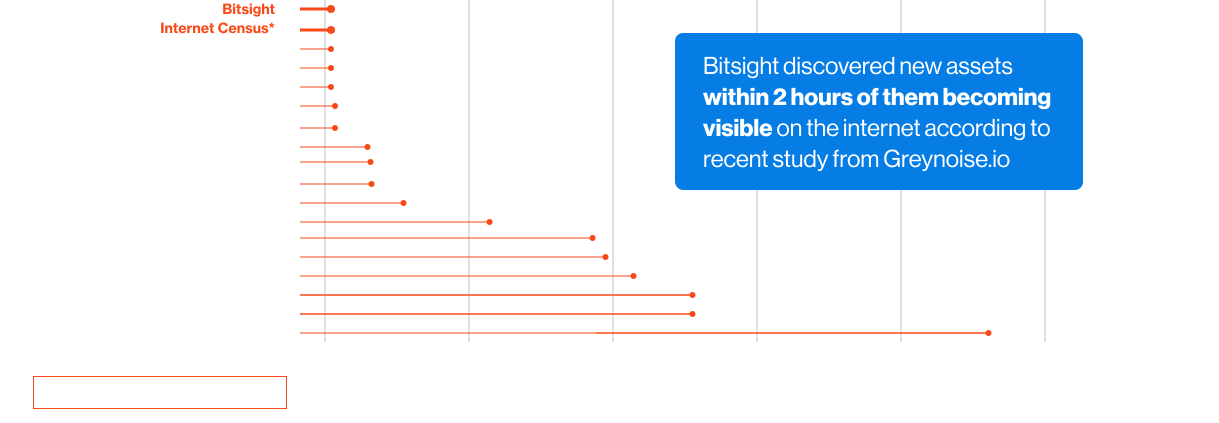
Bitsight, the leading provider in Cyber Risk Management, introduced the next-generation internet scanner Bitsight Groma in May 2024. This technology continuously scans the entire internet to discover assets, collect asset attribution evidence, and identify an ever-growing set of security observations, such as vulnerabilities and misconfigurations. Groma’s scanning activities presently encompass:


  • 40 million-plus monitored organizations
  • 250 million-plus host names
  • 4 billion-plus routable IPv4 and IPv6 addresses

Greynoise’s recent study testifies the speed of Bitsight Groma.

Bitsight data discovery
Governance charcoal background

Bitsight TRACE team investigates security incidents and identifies vulnerabilities and threats.

View latest security research 

See what you’re up against across the expanding attack surface. Prioritize what matters most. And mitigate where you’re most vulnerable.

External Attack Surface Management