
CVE-2023-49096 Details
Jellyfin is a Free Software Media System for managing and streaming media. In affected versions there is an argument injection in the VideosController, specifically the `/Videos//stream` and `/Videos//stream.` endpoints which are present in the current Jellyfin version. Additional endpoints in the AudioController might also be vulnerable, as they differ only slightly in execution. Those endpoints are reachable by an unauthenticated user. In order to exploit this vulnerability an unauthenticated attacker has to guess an itemId, which is a completely random GUID. It’s a very unlikely case even for a large media database with lots of items. Without an additional information leak, this vulnerability shouldn’t be directly exploitable, even if the instance is reachable from the Internet. There are a lot of query parameters that get accepted by the method. At least two of those, videoCodec and audioCodec are vulnerable to the argument injection. The values can be traced through a lot of code and might be changed in the process. However, the fallback is to always use them as-is, which means we can inject our own arguments. Those arguments land in the command line of FFmpeg. Because UseShellExecute is always set to false, we can’t simply terminate the FFmpeg command and execute our own. It should only be possible to add additional arguments to FFmpeg, which is powerful enough as it stands. There is probably a way of overwriting an arbitrary file with malicious content. This vulnerability has been addressed in version 10.8.13. Users are advised to upgrade. There are no known workarounds for this vulnerability.
View at NVD
Exploit prediction scoring system (EPSS) score for CVE-2023-49096
EPSS (Exploit Prediction Scoring System): EPSS predicts the likelihood that a vulnerability will be exploited in the wild. A higher percentage means a greater chance of an exploit occurring. The EPSS model produces a probability score between 0 and 1 (0 and 100%).
1.25 Probability of exploitation activity being observed over the next 30 days (66th percentile)
CVSS score for CVE-2023-49096
CVSS (Common Vulnerability Scoring System): An open framework owned and managed by FIRST.Org, Inc. that assigns a numerical score from 0 to 10 to software vulnerabilities to indicate their severity.
7.7 High
Products affected by CVE-2023-49096

CVE-2023-49096 Global Footprint

Top 10 Identified Countries

Country Observations Percentage
CN 1,361 67.51%
US 212 10.52%
DE 56 2.78%
KR 35 1.74%
FR 34 1.69%
GB 33 1.64%
CA 31 1.54%
TW 23 1.14%
HK 18 0.89%
BR 16 0.79%

Is CVE-2023-49096 part of your extended attack surface? Bitsight helps security leaders rapidly identify exposure and detect threats in order to prioritize, communicate, and mitigate risk.

View interactive product tours

CVE-2023-49096 Industry Footprint

Top 10 Identified Industries

*Service provider organizations (typically Technology and Telecommunications) are disproportionally represented in the results given their upstream ownership of end-user infrastructure. See our FAQs.

Industry* Observations Percentage
Telecommunications 241 52.39%
Technology 205 44.57%
Utilities 7 1.52%
Education 2 0.43%
Government/Politics 1 0.22%
Retail 1 0.22%
Food Production 1 0.22%
Media/Entertainment 1 0.22%
Business Services 1 0.22%

Bitsight, the leading provider in Cyber Risk Management, introduced the next-generation internet scanner Bitsight Groma in May 2024. This technology continuously scans the entire internet to discover assets, collect asset attribution evidence, and identify an ever-growing set of security observations, such as vulnerabilities and misconfigurations. Groma’s scanning activities presently encompass:


  • 40 million-plus monitored organizations
  • 250 million-plus host names
  • 4 billion-plus routable IPv4 and IPv6 addresses

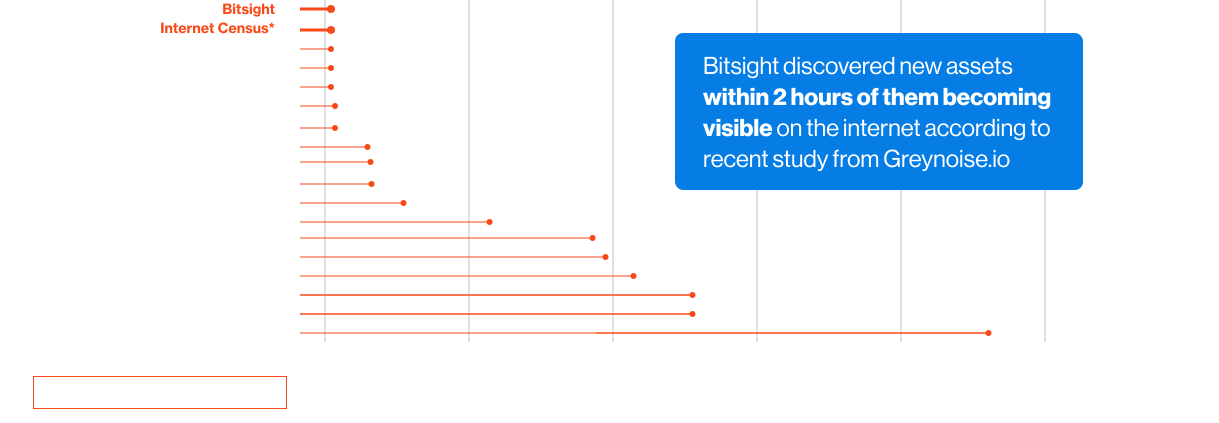
Greynoise’s recent study testifies the speed of Bitsight Groma.

Bitsight data discovery
Governance charcoal background

Bitsight TRACE team investigates security incidents and identifies vulnerabilities and threats.

View latest security research 

See what you’re up against across the expanding attack surface. Prioritize what matters most. And mitigate where you’re most vulnerable.

External Attack Surface Management