
CVE-2020-15810 Details
An issue was discovered in Squid before 4.13 and 5.x before 5.0.4. Due to incorrect data validation, HTTP Request Smuggling attacks may succeed against HTTP and HTTPS traffic. This leads to cache poisoning. This allows any client, including browser scripts, to bypass local security and poison the proxy cache and any downstream caches with content from an arbitrary source. When configured for relaxed header parsing (the default), Squid relays headers containing whitespace characters to upstream servers. When this occurs as a prefix to a Content-Length header, the frame length specified will be ignored by Squid (allowing for a conflicting length to be used from another Content-Length header) but relayed upstream.
View at NVD
Exploit prediction scoring system (EPSS) score for CVE-2020-15810
EPSS (Exploit Prediction Scoring System): EPSS predicts the likelihood that a vulnerability will be exploited in the wild. A higher percentage means a greater chance of an exploit occurring. The EPSS model produces a probability score between 0 and 1 (0 and 100%).
0.21 Probability of exploitation activity being observed over the next 30 days (44rd percentile)
CVSS score for CVE-2020-15810
CVSS (Common Vulnerability Scoring System): An open framework owned and managed by FIRST.Org, Inc. that assigns a numerical score from 0 to 10 to software vulnerabilities to indicate their severity.
6.5 Medium
Products affected by CVE-2020-15810

CVE-2020-15810 Global Footprint

Top 10 Identified Countries

Country Observations Percentage
US 1,263,733 73.78%
CA 145,189 8.48%
GB 77,087 4.50%
BR 61,034 3.56%
RO 49,594 2.90%
CN 18,519 1.08%
DE 14,759 0.86%
IN 13,156 0.77%
JP 11,180 0.65%
CH 8,322 0.49%

Is CVE-2020-15810 part of your extended attack surface? Bitsight helps security leaders rapidly identify exposure and detect threats in order to prioritize, communicate, and mitigate risk.

View interactive product tours

CVE-2020-15810 Industry Footprint

Top 10 Identified Industries

*Service provider organizations (typically Technology and Telecommunications) are disproportionally represented in the results given their upstream ownership of end-user infrastructure. See our FAQs.

Industry* Observations Percentage
Technology 302,764 90.21%
Telecommunications 30,096 8.97%
Utilities 1,289 0.38%
Education 611 0.18%
Media/Entertainment 265 0.08%
Government/Politics 167 0.05%
Business Services 86 0.03%
Finance 82 0.02%
Retail 66 0.02%
Consumer Goods 37 0.01%

Bitsight, the leading provider in Cyber Risk Management, introduced the next-generation internet scanner Bitsight Groma in May 2024. This technology continuously scans the entire internet to discover assets, collect asset attribution evidence, and identify an ever-growing set of security observations, such as vulnerabilities and misconfigurations. Groma’s scanning activities presently encompass:


  • 40 million-plus monitored organizations
  • 250 million-plus host names
  • 4 billion-plus routable IPv4 and IPv6 addresses

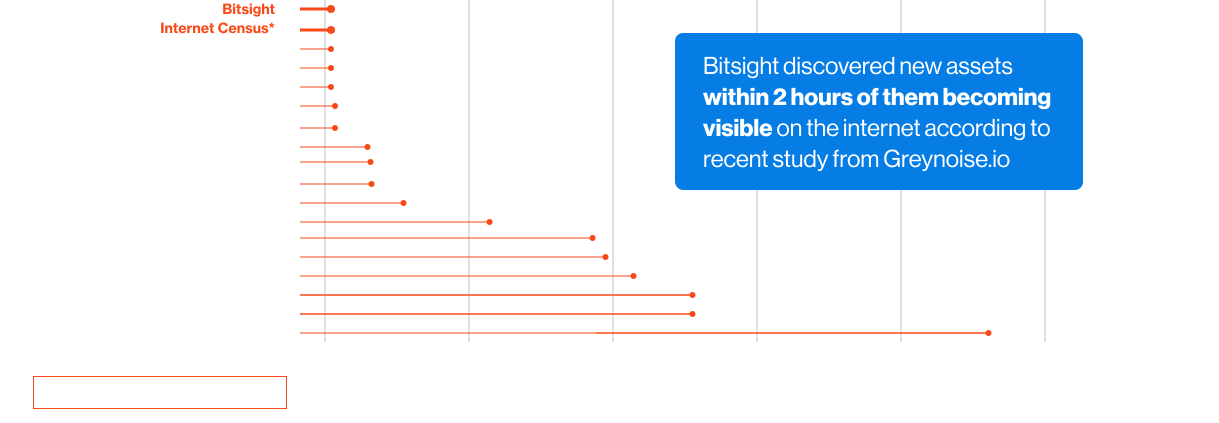
Greynoise’s recent study testifies the speed of Bitsight Groma.
Bitsight data discovery
Governance charcoal background

Bitsight TRACE team investigates security incidents and identifies vulnerabilities and threats.

View latest security research 

See what you’re up against across the expanding attack surface. Prioritize what matters most. And mitigate where you’re most vulnerable.

External Attack Surface Management

Bitsight ASA Report Image

Reducing exposure starts with knowing exactly how your external attack surface stands—from your overall standing to each digital and cloud asset around the world. Bitsight's custom report gives you the insights you need to see your entire external attack surface.